
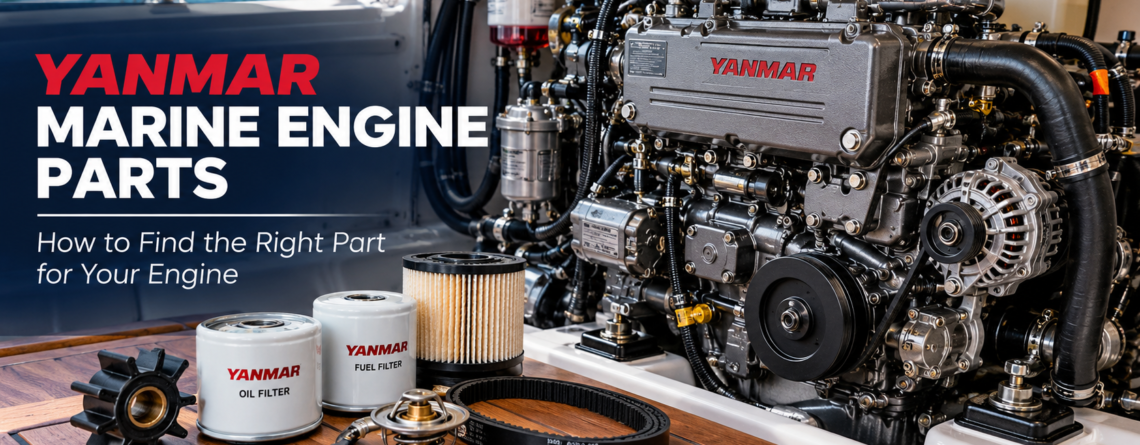
Buying a marine engine part sounds simple until you actually have to find one.
You search for the engine model, add the component you need, and suddenly you’re looking at pages of filters, pumps, injectors, impellers, gaskets, belts, sensors and other components.
Some look almost identical.
Some have similar descriptions.
Some are listed for several Yanmar engines.
And that’s where you need to slow down.
When it comes to Yanmar marine engine parts, the most important question isn’t simply:
“Where can I buy this part?”
It’s:
“How do I know this is the correct part for my exact engine and configuration?”
That distinction matters.
Yanmar itself says engine identification requires the complete model number and serial number, and its marine support guidance directs customers to authorized dealers or distributors for parts information and full parts lists.
At Coastal Wave Marine, that’s the principle we recommend starting with.
Identify first. Verify second. Order third.
Whether you’re looking for a routine maintenance component, a replacement cooling-system part, a fuel-system component, an electrical component, or parts associated with a larger repower, this guide will show you how to approach the process properly.
What Are Yanmar Marine Engine Parts?
Yanmar marine engine parts are the components used to maintain, repair, service or support Yanmar marine propulsion engines and their associated systems.
Depending on the engine and installation, that can include:
- Oil filters
- Fuel filters
- Fuel-system components
- Raw-water pump components
- Impellers
- Thermostats
- Heat-exchanger components
- Gaskets
- O-rings
- Belts
- Hoses
- Injectors
- Starters
- Alternators
- Sensors
- Electrical components
- Exhaust components
- Engine mounts
- Marine gears
- Saildrive-related components
Yanmar’s own maintenance-kit information illustrates how service requirements can vary by engine family, with kits containing combinations of fuel filters, oil filters, impellers, thermostats, gaskets, belts and other components.
That is an important point:
There isn’t one universal Yanmar parts list that applies to every Yanmar marine engine.
Your engine model and configuration matter.
Why the Correct Yanmar Marine Engine Part Matters
Marine engines don’t get to choose their operating environment.
They deal with:
- Heat
- Vibration
- Humidity
- Saltwater exposure
- Continuous engine loads
- Confined engine compartments
- Regular starting and stopping
- Long operating periods
So when a component needs replacement, “close enough” isn’t a particularly useful standard.
The correct question is whether the replacement component is appropriate for the specific engine and application.
A similar-looking part isn’t necessarily the same part
Two components can look nearly identical while differing in:
- Dimensions
- Materials
- Electrical characteristics
- Flow characteristics
- Pressure specifications
- Mounting arrangement
- Sealing arrangement
- Application
- Engine model
- Production or serial-number range
This is why Yanmar marine engine replacement parts should be selected using identification and compatibility information rather than appearance alone.
Yanmar’s marine support documentation specifically emphasizes model and serial-number identification when determining what engine a customer has.

The Major Categories of Yanmar Marine Engine Parts
Rather than looking at marine parts as one enormous catalog, it helps to divide them according to the system they support.
Yanmar Marine Fuel System Parts
Fuel-system components may include:
- Fuel filters
- Fuel-water separation components
- Fuel pumps
- Injectors
- Fuel lines
- Seals
- Related fuel-system components
If you’re searching for Yanmar marine fuel system parts, start with the engine model.
For example, don’t simply search:
Yanmar fuel injector
A better starting point is:
Yanmar [exact engine model] fuel injector
Then verify the applicable part information.
That’s particularly important because fuel-system components are specification-sensitive.
Yanmar Marine Engine Cooling System Parts
Cooling-system components can include:
- Raw-water pump components
- Impellers
- Thermostats
- Heat-exchanger components
- Hoses
- Gaskets
- O-rings
- Related cooling components
If you’re searching for Yanmar marine engine cooling system parts, identify the engine before selecting the component.
A cooling problem also shouldn’t automatically be interpreted as proof that one particular component has failed.
For example, reduced cooling performance could have multiple possible causes.
The correct process is:
Symptom → inspection/diagnosis → component identification → replacement
rather than:
Symptom → guess → order part
Yanmar Marine Engine Oil and Lubrication Parts
Routine lubrication-related components can include:
- Engine oil filters
- Seals
- Gaskets
- Oil-system components
- Other model-specific service parts
If you’re searching for Yanmar marine engine oil filter replacement, use the exact engine model and applicable maintenance information.
Yanmar’s marine guidance says owners should refer to the operation manual specific to their engine for oil, coolant and service information.
That’s a much safer approach than choosing a filter based only on physical appearance.
Yanmar Marine Air-Intake Parts
Air-intake components can include:
- Air filters
- Intake hoses
- Clamps
- Intake components
- Turbocharger-related components on applicable engines
The exact components depend on the engine.
For that reason, the engine model should be established before choosing a replacement.
Yanmar Marine Exhaust Parts
Depending on the engine and installation, exhaust-related components can include:
- Exhaust mixing elbows
- Exhaust hoses
- Exhaust gaskets
- Clamps
- Other exhaust components
The configuration can matter.
For example, Yanmar’s 4JH80 product information shows that its standard package includes an exhaust mixing elbow and that different exhaust arrangements are available.
That is a good example of why “Yanmar 4-cylinder exhaust part” isn’t enough information to identify a component accurately.
Yanmar Marine Engine Electrical Parts
Electrical components may include:
- Starter motors
- Alternators
- Sensors
- Switches
- Harnesses
- Electrical controls
- Monitoring components
Again, physical appearance isn’t enough.
Electrical specifications, mounting arrangements and engine configuration all need to be considered.
Yanmar Marine Engine Parts by Model
One of the strongest ways to improve a parts search is to add the engine model.
For example:
Yanmar 4JH80 marine engine parts
is far more specific than:
Yanmar marine parts
Likewise:
- Yanmar 3JH40 marine engine parts
- Yanmar 4JH110 marine engine parts
- Yanmar 1GM10 marine engine parts
- Yanmar 3YM30 marine engine parts
These searches establish the engine before you start narrowing down the component.
GM Series
The GM family includes compact marine engines such as the 1GM10.
When sourcing parts for an older or compact engine, provide the complete identification information rather than relying only on the engine family name.
YM Series
The YM family includes engines such as the 2YM15, 3YM20 and 3YM30.
Yanmar’s YM-series operation manual, for example, provides model-specific maintenance guidance and recommends genuine Yanmar parts when replacement parts are required.
JH-CR Series
The JH-CR family includes models such as:
- 3JH40
- 4JH45
- 4JH57
- 4JH80
- 4JH110
If you’re researching Yanmar 4JH80 marine engine parts, don’t assume that a component listed for another JH model automatically applies.
Yanmar’s 4JH80 documentation demonstrates how detailed the model-specific specifications can be, including displacement, cylinders, charging system, dimensions, controls and available packages.
4LV, 8LV, 6LY, 6LF and 6LT Families
Yanmar’s marine product range also includes higher-output propulsion engines.
As engine complexity and output increase, accurate identification becomes increasingly important.
For these engines, we recommend providing:
Complete model + serial number + component information + photographs
before attempting to finalize a parts recommendation.
How to Identify the Right Yanmar Marine Engine Part
This is the part of the process that can save you the most frustration.
Step 1: Identify the complete engine model
Find the engine identification information and record the complete model designation.
Don’t leave out additional characters simply because they seem unimportant.
Yanmar explicitly notes that complete model and serial-number information is required for engine identification.
Step 2: Record the serial number
The serial number provides another level of identification.
This becomes particularly useful when you’re dealing with an older engine, revised components or questions about applicability.
If you’re contacting Coastal Wave Marine about Yanmar marine engine parts, include the serial number whenever possible.
Step 3: Identify the component
Tell the supplier what you’re trying to replace.
For example:
“I need the raw-water pump.”
is more useful than:
“I need the thing near the front of the engine.”
But if you don’t know the component name, that’s fine.
Take photographs.
Step 4: Photograph the existing part
Take:
- One full-engine photograph
- One close-up
- Several different angles
- A photograph of any visible number or marking
- A photograph of the identification plate
Don’t worry about making the photographs beautiful.
Make them clear.
Step 5: Check the part number
If there is an identifiable part number, record it.
However, remember that a number stamped or cast onto a component isn’t necessarily the current manufacturer ordering number.
That distinction is why part identification should be verified rather than assumed.
Step 6: Check the configuration
Consider:
- Engine model
- Serial number
- Gear
- Saildrive
- Application
- Existing component
- Engine installation
A Yanmar engine isn’t necessarily an isolated component.
It is part of a propulsion system.
Step 7: Confirm before ordering
This is the final checkpoint.
If the application hasn’t been confirmed, don’t turn an uncertain identification into a purchase.
A few minutes of verification can be cheaper than an incorrect order.
Why the Engine Serial Number Is So Important
This deserves its own section because customers frequently underestimate its value.
Yanmar states that engine identification requires both the complete model number and serial number.
That makes the serial number an important piece of information when you’re trying to determine the correct component.
For customers, the practical takeaway is simple:
If you have the serial number, send it.
Even if you’re not sure whether it is necessary, it can help narrow the identification process.
OEM vs Aftermarket Yanmar Marine Engine Parts
This is one of the questions buyers naturally ask.
Should you buy a Genuine Yanmar component?
Or should you consider an aftermarket alternative?
The answer needs some nuance.
What Yanmar Says About Genuine Parts
Yanmar states that its Genuine Parts are manufactured to its specified quality and durability standards and that the company maintains a global network of authorized distributors and dealers.
Yanmar also says its Genuine Parts are designed specifically for Yanmar products.
For warranty considerations, Yanmar Marine’s FAQ warns that use of non-Yanmar parts may affect some or all warranty coverage depending on the circumstances.
That is important information for a buyer.
It doesn’t mean every aftermarket component is automatically unsuitable.
It means you should understand:
- Who manufactured it
- What it is designed for
- Whether compatibility has been established
- What warranty conditions apply
- Whether the application is documented
Genuine Yanmar Parts vs “Fits Yanmar” Parts
Here’s a distinction worth remembering.
“Genuine Yanmar” and “fits Yanmar” are not interchangeable descriptions.
A genuine manufacturer part is one thing.
A replacement component manufactured by another company and advertised as compatible is another.
If a listing says:
Fits Yanmar
don’t stop there.
Ask:
Fits which model?
Which serial range?
Which configuration?
Which application?
What is the manufacturer’s part/reference number?
That is how you move from a marketing claim to a compatibility question.
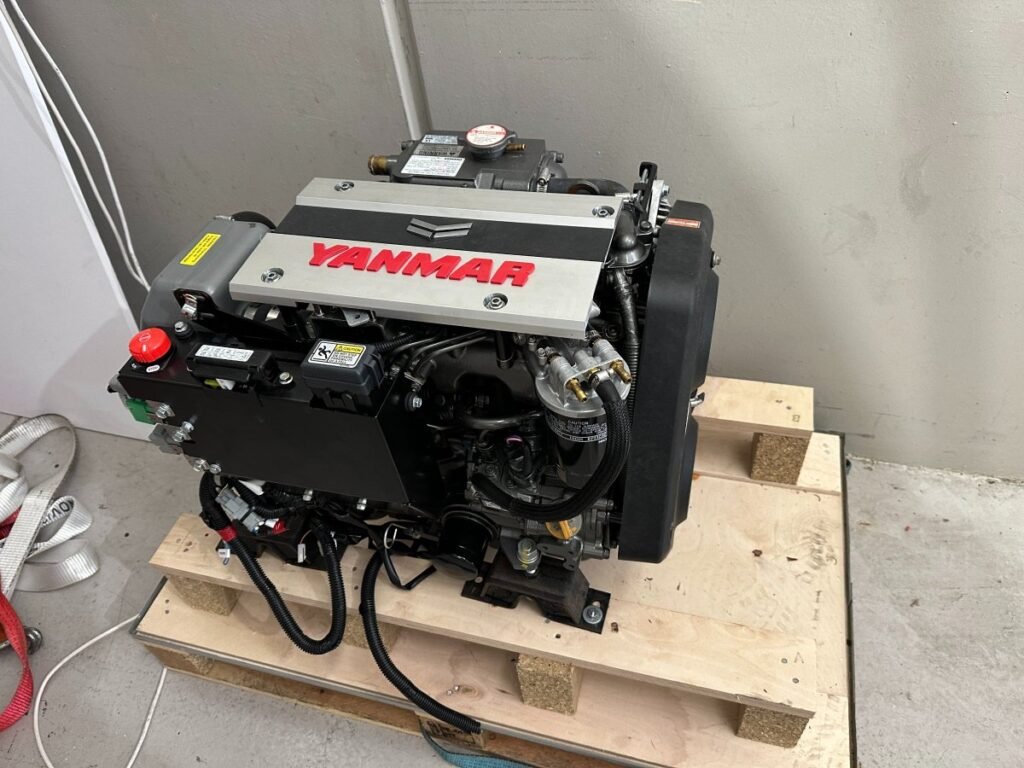
How to Search for Yanmar Marine Engine Parts Online
Search engines are much more useful when you give them specific information.
Search by engine model
Instead of:
Yanmar parts
try:
Yanmar 4JH80 marine engine parts
That immediately establishes the engine.
Search by model and component
Even better:
Yanmar 3JH40 impeller
or:
Yanmar 4JH110 fuel injector
or:
Yanmar 4JH80 oil filter
This is much closer to the way a parts professional approaches the problem.
Search by part number
If you have a verified part number, searching by that reference can narrow the results considerably.
But remember:
A search result is not the same thing as a compatibility confirmation.
Always verify before purchasing.
Yanmar Marine Engine Part Numbers: What You Need to Know
Part numbers can become confusing when an engine has been supported for many years.
You may encounter:
- Original part numbers
- Updated numbers
- Superseded numbers
- Reference numbers
- Component markings
- Manufacturer numbers
So if an old part number doesn’t appear in a current online listing, don’t immediately assume that the component is impossible to source.
It may have been replaced by a newer reference.
This is one of the reasons Yanmar directs customers to its distributor/dealer network for detailed parts information and full parts lists.
What Information Should You Send a Marine Parts Supplier?
If you’re contacting Coastal Wave Marine, here’s the information that makes the conversation much more productive.
Send the engine information
Engine model:
Yanmar [complete model]
Serial number:
[serial number]
Send the component information
Part needed:
[component]
Existing part number:
[number if available]
Send vessel information
Boat:
[make/model]
Year:
[year if known]
Send photographs
Ideally:
- Engine identification plate
- Full engine
- Existing component
- Close-up of markings
- Gearbox/saildrive if relevant
Send quantity
For example:
Quantity: 2
Send destination
Include the location where the parts need to be shipped.
This allows the supplier to understand the complete request before discussing the next step.
Common Mistakes When Buying Yanmar Marine Engine Parts
Mistake 1: Buying based on the photograph
Two components can look nearly identical.
Don’t use appearance as your primary compatibility test.
Mistake 2: Giving only the engine family
“JH series” may not provide enough information.
Provide the complete model and serial number.
Mistake 3: Ignoring the serial number
Yanmar specifically identifies the complete model and serial number as important identification information.
Mistake 4: Assuming “fits Yanmar” means “fits my Yanmar”
It doesn’t necessarily.
Mistake 5: Replacing a component before diagnosing the problem
A symptom can have several possible causes.
Mistake 6: Ignoring the operation manual
Yanmar recommends using the operation manual specific to the engine for maintenance information.
Mistake 7: Treating a search result as proof
Google can find a listing.
It doesn’t verify your engine configuration for you.
Yanmar Marine Engine Parts for Routine Maintenance
Some of the most common parts searches aren’t emergency repairs at all.
They’re maintenance items.
Yanmar offers model-specific maintenance kits containing combinations of service components. Its published marine examples include items such as fuel elements, oil elements, impellers, thermostats, gaskets, O-rings, zinc-related components and belts, depending on the engine.
This is why it can make sense to plan maintenance rather than wait for a component to fail.
Your exact maintenance requirements should come from the documentation applicable to your engine.
Yanmar’s support guidance emphasizes following the operation manual for maintenance information and service intervals.
When You Need a Part—and When You Need Diagnosis
This is one of the biggest differences between buying a random replacement part and working with an experienced marine-engine supplier.
Suppose the engine overheats.
You could immediately order an impeller.
But what if the actual issue is elsewhere?
Or suppose the engine is difficult to start.
You could order a fuel component.
But what if the underlying issue is electrical?
The correct workflow is:
Problem → Diagnosis → Failed component → Correct part
That approach reduces unnecessary parts replacement.
It also protects your budget.
Yanmar Marine Engine Parts and Repowering
If you’re planning a repower, the parts conversation becomes considerably broader.
You’re no longer asking only:
“Which replacement engine?”
You’re evaluating a propulsion system.
That may involve:
- Engine
- Marine gear
- Saildrive
- Engine mounts
- Controls
- Exhaust
- Cooling connections
- Electrical connections
- Shafting
- Propeller
- Installation dimensions
Yanmar’s own 4JH80 documentation demonstrates this system-level approach by publishing technical drawings for different marine-gear and saildrive configurations.
That is exactly why repower projects should be evaluated as complete installations rather than simply horsepower substitutions.
How Coastal Wave Marine Approaches Yanmar Marine Engine Parts
This is where we believe a marine-engine vendor should provide more value than a basic product listing.
Our recommended process is:
1. Identify the engine
Start with the complete model and serial number.
2. Understand the application
Find out what vessel the engine is installed in and what component is being requested.
3. Identify the part
Use the component description, photographs, existing markings and available documentation.
4. Verify the application
Don’t treat a similar-looking component as proof of compatibility.
5. Confirm the order information
Before the purchase is finalized, make sure the model, component, quantity and destination are clear.
This is a much safer process than simply searching a keyword and choosing the first result.
What Makes a Good Yanmar Marine Parts Supplier?
If you’re comparing suppliers, don’t look only at price.
Ask whether the supplier can help answer basic questions such as:
- What information is needed to identify my engine?
- Can you verify the part number?
- Do you need the serial number?
- Is the part genuine or aftermarket?
- What application has been confirmed?
- Is availability confirmed?
- What shipping method is available?
- What warranty applies?
A trustworthy supplier shouldn’t have to guess.
And a trustworthy customer shouldn’t have to guess either.
The objective is to get enough information on the table to make an informed purchase.

Frequently Asked Questions About Yanmar Marine Engine Parts
Where can I buy Yanmar marine engine parts?
Yanmar states that Genuine Parts are available through its authorized distributor and dealer network. Coastal Wave Marine can assist customers with the identification and sourcing process for applicable Yanmar marine components, subject to confirmation of the specific engine and part.
How do I find the correct Yanmar marine engine part?
Start with the complete engine model and serial number. Then identify the component and verify the applicable part information.
Yanmar specifically states that complete model and serial-number information is required for engine identification.
Do Yanmar marine engine parts vary by model?
They can. Different models and configurations can use different components.
That’s why you should verify the specific engine rather than assuming that a part advertised for one Yanmar model applies to another.
Are Genuine Yanmar Parts different from aftermarket parts?
Yes. Genuine Yanmar Parts are manufactured under Yanmar’s specified quality processes and are designed for Yanmar equipment. Yanmar also acknowledges that aftermarket parts exist but does not recommend or defend the use of non-Yanmar parts in its marine FAQ.
How do I find a Yanmar marine engine part number?
Start with the engine model, serial number, existing component and available documentation. For detailed parts information and full parts lists, Yanmar directs customers to its dealer/distributor network.
Can I order a Yanmar part using only a photograph?
A photograph can be extremely useful, but it shouldn’t automatically be treated as sufficient identification.
Ideally, provide the engine model and serial number alongside the photograph.
What information should I send when requesting a Yanmar part?
Send:
- Complete engine model
- Serial number
- Existing part number if available
- Component description
- Clear photographs
- Vessel information
- Quantity
- Shipping destination
What Yanmar parts are commonly replaced during maintenance?
Depending on the engine, maintenance components can include filters, impellers, thermostats, gaskets, O-rings, belts and other service parts. Yanmar publishes model-specific maintenance information and kits.
Can I use aftermarket Yanmar marine engine parts?
Aftermarket components are available in the market, but compatibility and warranty considerations should be evaluated carefully. Yanmar states that use of non-Yanmar parts may affect some or all warranty coverage.
Can Coastal Wave Marine help identify my Yanmar part?
Yes. The most useful starting information is your complete engine model, serial number, component description and clear photographs. If you have an existing part number, include that as well.
Yanmar Marine Engine Parts: Your Pre-Order Checklist
Before placing an order, go through this list.
☐ Complete engine model identified
☐ Serial number recorded
☐ Component identified
☐ Existing part number photographed
☐ Engine photographs taken
☐ Application identified
☐ Configuration considered
☐ Genuine vs aftermarket requirement understood
☐ Quantity confirmed
☐ Shipping destination provided
☐ Compatibility information verified
If you can’t check several of those boxes, that’s okay.
It simply means you may need more information before ordering.
Final Thoughts: Don’t Guess When Buying Yanmar Marine Engine Parts
The easiest way to make Yanmar marine engine parts complicated is to start with the part.
Start with the engine instead.
Model.
Serial number.
Application.
Component.
Part number.
Compatibility.
Then purchase.
That sequence is simple, but it makes a major difference.
Yanmar itself places significant emphasis on model-specific documentation, authorized support, Genuine Parts and accurate engine identification.
At Coastal Wave Marine, that’s the standard we want customers to follow as well.
If you’re searching for Yanmar marine engine parts for sale, don’t worry if you don’t know the exact technical name of the component.
Send us what you do know.
Give us the complete engine model.
Give us the serial number.
Send clear photographs.
Include the existing part number if one is visible.
Tell us what boat the engine is installed in.
From there, the goal is to establish exactly what information is needed to identify the appropriate component rather than guessing from a photograph or generic product description.
Because when your boat is sitting at the dock waiting for a part, the cheapest part isn’t necessarily the cheapest solution.
The right part, correctly identified the first time, is what matters.
Need Yanmar Marine Engine Parts?
Contact Coastal Wave Marine with your engine model, serial number, existing part number and clear photographs of the component you’re trying to replace.
We’ll use those details to determine what needs to be verified before moving forward with the part request.
Next Post: Yanmar Marine Engine Models: The Complete Guide to Every Series, Size & Application

Leave a Reply