
If you’re researching Yanmar marine engine models, there’s a good chance you’re already dealing with one of two situations.
Either you’re trying to understand which Yanmar engine is right for your boat, or you’re replacing an existing engine and don’t want to make an expensive compatibility mistake.
And that’s where things get interesting.
Choosing a marine engine isn’t like choosing a car engine from a specification sheet. You can’t simply look at horsepower, pick the biggest number that fits your budget, and assume you’ve made the right decision.
The engine has to work with the vessel.
It has to work with the propulsion system.
And it has to work with the gearbox, saildrive, propeller, shafting, controls, cooling system, exhaust arrangement and available installation space.
That’s the approach we take at Coastal Wave Marine when helping customers evaluate Yanmar marine engines.
The first question shouldn’t always be:
“How much horsepower do you want?”
A better question is:
“What are you trying to power, what is installed now, and what does the complete propulsion system require?”
That distinction can save you from buying an engine that looks perfect on paper but creates problems when installation day arrives.
Yanmar’s current marine diesel range covers approximately 9 to 640 MHP, with engine families ranging from compact sailboat diesels to high-output powerboat and commercial propulsion engines. Yanmar currently lists the GM, YM, JH-CR, 4LV, 8LV, 6LY-CR, 6LF and 6LT families in its marine portfolio.
This guide explains the major Yanmar marine engine models, what separates the engine families, where the different power ranges fit, and what you should check before purchasing a Yanmar engine for a new installation or repower.
Yanmar Marine Engine Models at a Glance
The current Yanmar marine diesel range is broad enough to cover very different vessel requirements.
| Yanmar Series | Current Listed Output Range | General Positioning |
|---|---|---|
| 1GM10 / GM | 9 MHP | Compact sailboat and small-craft propulsion |
| YM Series | 14–29.1 MHP | Small sailboats and craft |
| JH-CR Series | 40–110 MHP | Sailboat and small-craft propulsion |
| 4LV Series | 150–250 MHP | Powerboat propulsion |
| 8LV Series | 320–370 MHP | Higher-output powerboat propulsion |
| 6LY-CR Series | 400–440 MHP | High-output powerboat propulsion |
| 6LF Series | 485–550 MHP | High-output marine propulsion |
| 6LT Series | 500–640 MHP | High-output marine propulsion |
These are the current families and output ranges presented by Yanmar Marine International.
One important detail is easy to miss: Yanmar’s engine search also distinguishes between current and legacy engines and filters models according to applications such as sailboat & small craft, powerboat and light-duty commercial use.
That matters if you’re replacing an older Yanmar.
The engine you currently have may no longer be part of the current production range, so identifying the existing model is only the beginning. The real job is finding a suitable current replacement and determining what else needs to change around it.
The Smallest Yanmar Marine Engine Models
Yanmar 1GM10
The Yanmar 1GM10 remains an important reference point when discussing compact marine diesel engines.
Yanmar currently lists the 1GM10 at 9 MHP, 3,600 RPM, with a 0.318-liter displacement and one cylinder. Yanmar describes it as a naturally aspirated engine designed for pleasure craft and available with a marine gear or saildrive arrangement.
That tells us something important about engine selection.
A small engine isn’t necessarily a “basic” choice that should automatically be replaced by something larger.
For a vessel designed around compact auxiliary propulsion, the relevant questions include:
- How much power does the hull actually require?
- What is the existing engine-bed arrangement?
- What gearbox or saildrive is installed?
- What propeller is being used?
- How much space is available?
- What changes would a larger engine require?
When evaluating a Yanmar marine engine replacement, these questions can be more useful than simply asking whether another engine produces more horsepower.
Yanmar YM Series: 15–30 MHP
The YM Series occupies the next compact segment of the Yanmar lineup.
Current models include:
- 2YM15
- 3YM20
- 3YM30AE
Yanmar lists the models at approximately 14, 21 and 29.1 MHP, respectively.
These models are particularly relevant when researching Yanmar sailboat engines, small auxiliary propulsion systems and compact diesel replacements.
Yanmar 2YM15
The 2YM15 is positioned at the lower end of this family.
When evaluating an engine in this range, don’t focus only on the 15-MHP figure. Compare the vessel’s displacement and propulsion requirements with the engine’s physical dimensions, rated speed and drivetrain configuration.
Yanmar 3YM20
The 3YM20 moves into the 20-MHP class.
For owners comparing Yanmar marine engine models by horsepower, this is where the distinction between a basic horsepower comparison and a real installation assessment becomes important.
Yanmar 3YM30AE
The 3YM30AE provides approximately 29.1 MHP and sits at the upper end of the YM family.
For a replacement project, the key question isn’t simply whether the output is adequate.
You also need to know whether the engine can be integrated with the existing propulsion arrangement without creating unnecessary modification work.
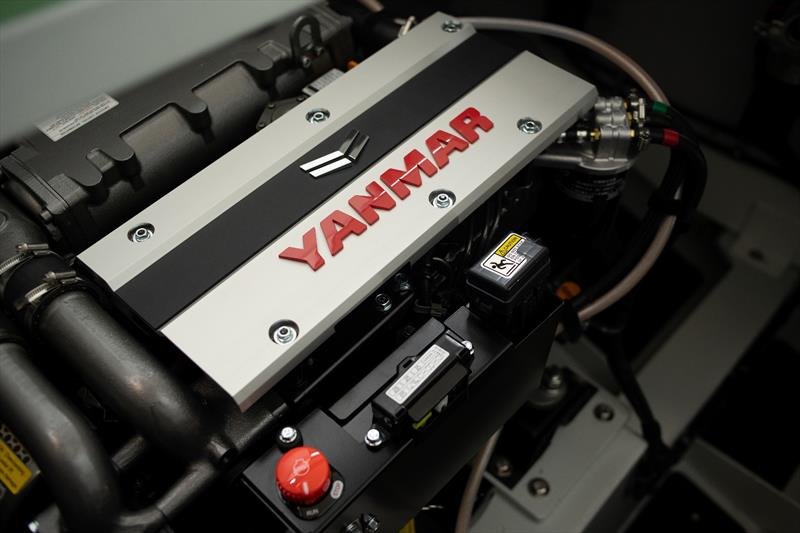
Yanmar JH-CR Series: 40–110 MHP
For many customers researching Yanmar marine engine models for sailboats and small craft, the JH-CR Series is where the search becomes especially interesting.
Yanmar currently lists five models:
- 3JH40
- 4JH45
- 4JH57
- 4JH80
- 4JH110
The series covers 40 to 110 MHP. Yanmar describes it as a major propulsion range for sailboats and small craft.
The models aren’t simply different horsepower versions of the same purchasing decision.
Their output, rated speed, aspiration and configuration all need to be considered.
Yanmar 3JH40
The 3JH40 is rated at 40 MHP at 3,000 RPM.
Yanmar lists:
- 3 cylinders
- 1.642-liter displacement
- Bosch common-rail direct injection
- Natural aspiration
- 192 kg dry weight without gear
- 774 × 580 × 632 mm dimensions
Yanmar also notes that the published dimensions can vary depending on the gear and exhaust-elbow configuration.
That last point is exactly the type of detail that matters during repowering.
Imagine finding an engine with the correct horsepower and then discovering that the gearbox configuration changes the overall installation length.
That’s why technical drawings and configuration-specific specifications should be checked before an order is finalized.
Yanmar provides technical drawings for the 3JH40 with several gear configurations and identifies compatible drive products on its product page.
Yanmar 4JH45
The 4JH45 is rated at 45 MHP at 3,000 RPM. It belongs to the same JH-CR family as the 3JH40 but should not be evaluated simply by looking at the five-horsepower difference.
For a replacement project, compare:
- Existing engine output
- Rated RPM
- Physical dimensions
- Engine-bed arrangement
- Gearbox
- Propeller
- Shaft or saildrive
- Controls
- Vessel displacement
That’s how you determine whether the model is actually appropriate.
Yanmar 4JH57
The 4JH57 raises output to 57 MHP at 3,000 RPM.
For buyers searching for a Yanmar 57 HP marine engine, this model may look like a straightforward step up from the 4JH45.
But marine propulsion doesn’t work that way.
The additional output needs to be considered alongside the drivetrain.
If the propeller, gearbox ratio or installation was designed around a different engine, the repower may require more than simply removing one engine and installing another.
Yanmar 4JH80
The Yanmar 4JH80 is one of the key models in the JH-CR range.
Yanmar lists it at:
- 80 MHP
- 3,200 RPM
- 2.0-liter displacement
- 4 cylinders
- Bosch common-rail direct injection
- Turbocharged and intercooled
- 229 kg dry weight without gear
- 909 × 613 × 675 mm dimensions
Yanmar notes that the listed length includes a KM4A2 marine gear and that dimensions can vary with other gears and exhaust-elbow configurations.
That is a perfect example of why a professional Yanmar marine engine supplier should look at configuration, not merely the base engine.
Yanmar’s own documentation provides technical drawings for multiple gearbox configurations, including Kanzaki and ZF options, as well as saildrive configurations.
So if you’re considering a Yanmar 80 HP marine engine, don’t stop at the engine specification.
Confirm the propulsion configuration.
Yanmar 4JH110
The 4JH110 takes the JH-CR family to 110 MHP.
Yanmar lists the engine at:
- 110 MHP
- 3,200 RPM
- 2.0-liter displacement
- 4 cylinders
- Bosch common-rail direct injection
- Turbocharged and intercooled
- 229 kg dry weight without gear
- 909 × 613 × 675 mm dimensions
Yanmar’s specifications also note that the dimensions can change with different gear and elbow configurations.
An interesting detail is that the published base dimensions and dry weight for the 4JH80 and 4JH110 are the same on Yanmar’s product pages.
That illustrates why the model number alone doesn’t tell you everything about installation.
If you’re comparing the Yanmar 4JH80 vs 4JH110, the output requirement, vessel application, propulsion configuration and technical compatibility deserve more attention than simply choosing the larger number.
Yanmar 4LV Series: 150–250 MHP
The 4LV Series moves into Yanmar’s powerboat-focused range.
Current models include:
- 4LV150
- 4LV170
- 4LV195
- 4LV230
- 4LV250
Yanmar lists the family from 150 to 250 MHP and describes the 2.8-liter series as combining low noise and vibration with low-end torque and acceleration.
The first three models are rated at 3,500 RPM, while the 4LV230 and 4LV250 are rated at 3,800 RPM.
That difference is worth paying attention to.
When comparing Yanmar marine engine specifications, don’t look only at the horsepower column.
Rated speed can affect the way the engine integrates with the propulsion system.
4LV150 and 4LV170
These engines occupy the lower end of the 4LV family.
For powerboat applications, the appropriate choice depends on the vessel’s hull, weight, desired performance and drive configuration.
The objective should be sufficient propulsion performance without selecting an engine that is unnecessarily mismatched to the boat.
4LV195
The 4LV195 sits close to the 200-MHP class.
If you’re comparing engines in this range, evaluate the complete propulsion package rather than treating 195 MHP as an isolated specification.
4LV230 and 4LV250
The 4LV230 and 4LV250 represent the upper end of the 4LV range.
Yanmar lists them at 230 and 250 MHP respectively.
These engines are particularly relevant when researching Yanmar powerboat engines and higher-output marine repower projects.
Yanmar 8LV Series: 320–370 MHP
The 8LV Series takes the range into the 300-plus horsepower category.
Current models include:
- 8LV320
- 8LV350
- 8LV370
Yanmar lists the family from 320 to 370 MHP.
At this output level, the selection process becomes increasingly application-specific.
The vessel’s hull design, weight, desired cruising performance, drive system and installation arrangement all become important.
For twin-engine vessels, the evaluation also needs to consider how the engines will work together as a propulsion package.
Yanmar 6LY-CR Series: 400–440 MHP
The 6LY-CR Series currently covers approximately 400 to 440 MHP.
These engines occupy a significantly different part of the market from compact sailboat diesels.
For a high-output powerboat, the evaluation should include:
- Required horsepower
- Rated RPM
- Vessel displacement
- Hull characteristics
- Drive configuration
- Gear ratio
- Propeller or drive system
- Fuel requirements
- Cooling
- Exhaust
- Installation space
- Service access
The higher the output, the less sensible it becomes to make the decision from a horsepower number alone.
Yanmar 6LF Series: 485–550 MHP
Yanmar’s current 6LF range includes:
- 6LF485
- 6LF530
- 6LF550
with outputs from 485 to 550 MHP.
For customers researching high horsepower Yanmar marine engines, these models represent a substantially different propulsion requirement from the JH-CR or YM families.
At this level, installation engineering and propulsion-system matching become central to the buying decision.
Yanmar 6LT Series: 500–640 MHP
At the upper end of Yanmar’s current marine diesel range is the 6LT Series.
Current models include:
- 6LT500
- 6LT580
- 6LT640
Yanmar lists the family from 500 to 640 MHP.
This gives Yanmar a remarkably broad diesel portfolio, from the compact 1GM10 to the 640-MHP 6LT640.
But that broad range is exactly why model selection needs to begin with the vessel.

Yanmar Marine Engine Models by Horsepower
If you’re searching specifically for Yanmar marine engines by horsepower, this is a useful way to narrow your research.
Under 30 MHP
- 1GM10
- 2YM15
- 3YM20
- 3YM30AE
30–60 MHP
- 3JH40
- 4JH45
- 4JH57
60–120 MHP
- 4JH80
- 4JH110
120–300 MHP
- 4LV150
- 4LV170
- 4LV195
- 4LV230
- 4LV250
Above 300 MHP
- 8LV Series
- 6LY-CR Series
- 6LF Series
- 6LT Series
Yanmar’s current product catalog supports this overall progression.
However, treat horsepower as the first filter, not the final answer.
How We Evaluate a Yanmar Marine Engine for Repowering
This is where real-world engine selection differs from reading an online catalog.
Suppose you have an older diesel in a sailboat.
You know the existing engine produces 40 or 50 horsepower.
It would be easy to search for a modern Yanmar engine with similar output and assume you’ve found your replacement.
That’s not enough.
Before recommending a replacement, the relevant information includes:
Existing Engine
- Manufacturer
- Model
- Serial number
- Rated horsepower
- Rated RPM
- Dimensions
- Weight
Propulsion System
- Gearbox model
- Reduction ratio
- Shaft diameter
- Propeller specifications
- Saildrive model, if applicable
Vessel
- Make and model
- Length
- Displacement
- Hull type
- Intended operating profile
Installation
- Engine-bed dimensions
- Available height
- Width
- Length
- Exhaust arrangement
- Cooling arrangement
- Service clearance
Documentation
Photographs are extremely useful.
A clear photograph of the engine plate, gearbox, mounting arrangement and engine compartment can reveal information that a short product description cannot.
That’s why, at Coastal Wave Marine, we would rather have the right information before the quotation than discover a compatibility issue after an engine has been ordered.
Why Engine Dimensions Matter More Than Most Buyers Realize
One of the most common mistakes in marine repowering is assuming:
“The new engine has similar horsepower, so it should fit.”
Not necessarily.
Even when two engines have similar output, their:
- mounting points,
- overall dimensions,
- exhaust position,
- gearbox,
- shaft alignment,
- service clearances,
- electrical connections
can differ.
Yanmar’s own 4JH80 and 4JH110 documentation explicitly notes that dimensions can vary depending on gear and exhaust-elbow configuration.
That’s why technical drawings are not optional reading for a serious repower.
They’re part of the selection process.
Don’t Forget the Yanmar Marine Gearbox or Saildrive
The engine is only one part of the propulsion system.
If you’re researching Yanmar marine engine models, you should also investigate the appropriate Yanmar marine gearbox or saildrive arrangement.
For example, Yanmar provides technical drawings for multiple gear configurations and saildrives with the 4JH80.
That means a proper evaluation should consider:
Engine + Gearbox/Saildrive + Shaft + Propeller + Controls
rather than:
Engine + horsepower
This distinction is particularly important during repowering.
A replacement engine can have the correct power rating and still require significant drivetrain modifications.
Why More Horsepower Isn’t Always Better
This is probably the most important advice in this entire guide.
If your boat currently uses an 80-MHP engine, you might naturally think a 110-MHP replacement is an upgrade.
Maybe.
But maybe not.
More power can affect:
- Propeller loading
- Gearbox selection
- Fuel consumption
- Cooling requirements
- Exhaust requirements
- Engine mounts
- Weight distribution
- Operating characteristics
- Installation requirements
The correct question is:
Can the vessel and propulsion system use the additional power appropriately?
If the answer isn’t clear, don’t order the larger engine simply because the specification looks better.
Naturally Aspirated vs Turbocharged Yanmar Marine Engines
Another useful distinction when comparing Yanmar marine engine models is aspiration.
The 3JH40, for example, is listed by Yanmar as naturally aspirated.
The 4JH80 and 4JH110 are listed as turbocharged and intercooled.
Turbocharging allows greater output from a given engine displacement, but “turbocharged” doesn’t automatically mean “better.”
It means the engine is designed differently for its intended output and operating characteristics.
The appropriate question is not:
“Which technology sounds more advanced?”
It’s:
“Which engine technology and output are appropriate for my vessel?”
Common Rail Technology in Yanmar Marine Engines
Common-rail fuel injection is another important feature in modern Yanmar engines.
Yanmar describes common-rail technology as part of its marine-engine technology strategy.
The JH-CR models, including the 3JH40, use Bosch common-rail direct injection.
For a buyer, the important point isn’t simply that an engine is “common rail.”
You should also consider:
- Electronic controls
- Monitoring
- Diagnostics
- Vessel integration
- Installation requirements
- Service support
Modern engine technology can provide significant advantages, but it also reinforces the importance of proper installation and correct configuration.
The 10 Mistakes We Tell Marine Engine Buyers to Avoid
1. Choosing by horsepower alone
Horsepower is only one part of the specification.
2. Ignoring rated RPM
Engine speed and drivetrain requirements need to work together.
3. Assuming similar dimensions
Always verify the actual configuration.
4. Forgetting the gearbox
The engine and gearbox should be evaluated together.
5. Ignoring the propeller
Propeller selection is part of propulsion matching.
6. Assuming every Yanmar is interchangeable
Different engine families serve very different applications.
7. Ignoring service access
An engine that technically fits but cannot be serviced properly is a poor installation.
8. Choosing the biggest engine available
More power isn’t automatically better.
9. Failing to identify the existing engine
Model and serial information can be critical during replacement.
10. Ordering before confirming configuration
Get the technical details right first.
Then finalize the purchase.
What Makes a Good Yanmar Marine Engine Supplier?
A good supplier should do more than provide a price.
They should help you understand what you’re actually buying.
That means being able to discuss:
- Engine model
- Horsepower
- Rated RPM
- Application
- Dimensions
- Weight
- Gearbox
- Saildrive
- Propeller considerations
- Controls
- Installation
- Replacement requirements
- Documentation
This is particularly important when purchasing a Yanmar marine engine for sale for an existing vessel.
A cheap engine that creates thousands of dollars in unexpected installation modifications isn’t necessarily a cheap engine.
The better approach is to understand the complete project before committing.
Why Coastal Wave Marine Takes an Application-First Approach
At Coastal Wave Marine, our goal is not to push every customer toward the largest or most expensive Yanmar engine.
The right engine depends on the vessel.
If you’re contacting us about a Yanmar engine, useful information includes:
- Your current engine model
- Serial number
- Horsepower
- Rated RPM
- Vessel make and model
- Vessel length
- Vessel displacement
- Existing gearbox
- Gear ratio
- Saildrive information
- Propeller specifications
- Engine-room dimensions
- Photos of the installation
- Delivery destination
With that information, the conversation becomes much more useful.
Instead of:
“I need a Yanmar engine.”
we can work toward:
“I have this vessel, this existing engine, this drivetrain and this installation requirement. Which Yanmar configuration should I evaluate?”
That’s the conversation you want before making a major marine-engine purchase.

Which Yanmar Marine Engine Model Is Right for Your Boat?
There isn’t one universal answer.
For a compact sailboat, the 1GM10 or YM Series may be relevant.
For a larger sailing vessel or small craft, the JH-CR family may be more appropriate.
For powerboats, Yanmar’s current portfolio moves into the 4LV, 8LV, 6LY-CR, 6LF and 6LT families. Yanmar’s current powerboat-engine range is listed from 150 to 640 MHP.
But the correct selection still depends on the vessel.
Think of the process this way:
Step 1 — Identify the vessel
Step 2 — Identify the existing engine
Step 3 — Establish the required power
Step 4 — Verify RPM
Step 5 — Check dimensions
Step 6 — Check gearbox or saildrive
Step 7 — Check propeller and shaft requirements
Step 8 — Check controls and electrical integration
Step 9 — Review installation requirements
Step 10 — Confirm the complete configuration before ordering
That process is far more reliable than choosing an engine from horsepower alone.
Frequently Asked Questions About Yanmar Marine Engine Models
What are the current Yanmar marine engine models?
Yanmar’s current marine diesel portfolio includes the GM, YM, JH-CR, 4LV, 8LV, 6LY-CR, 6LF and 6LT families. The current listed range extends from approximately 9 MHP to 640 MHP.
What is the smallest Yanmar marine diesel engine?
The current 1GM10 is listed at approximately 9 MHP and uses a one-cylinder, 0.318-liter naturally aspirated diesel configuration.
What is the most powerful Yanmar marine engine?
Yanmar’s current marine diesel range reaches the 6LT640, rated at approximately 640 MHP.
What are the Yanmar JH-CR models?
The current JH-CR Series includes the 3JH40, 4JH45, 4JH57, 4JH80 and 4JH110, ranging from 40 to 110 MHP.
What is the difference between the 4JH80 and 4JH110?
Both are four-cylinder, 2.0-liter, turbocharged and intercooled engines with Bosch common-rail direct injection and a rated speed of 3,200 RPM. The 4JH80 is rated at 80 MHP, while the 4JH110 is rated at 110 MHP.
What is the best Yanmar marine engine for a sailboat?
There is no single best model for every sailboat.
The correct choice depends on vessel size, displacement, propulsion requirements, existing installation, gearbox or saildrive and propeller configuration.
The JH-CR family is specifically positioned by Yanmar for sailboat and small-craft propulsion.
Which Yanmar marine engine is best for repowering?
The best replacement depends on the existing installation.
Before choosing a replacement, compare the existing engine’s horsepower, RPM, dimensions, mounting arrangement, gearbox, saildrive, shaft and propeller.
Can a Yanmar engine work with a saildrive?
Yes. Yanmar offers marine-engine configurations with saildrive options. For example, Yanmar’s 4JH80 documentation identifies compatible saildrive configurations including the SD60 and other drive arrangements.
Should I replace the gearbox when replacing my engine?
Not necessarily.
The answer depends on the existing gearbox, ratio, output connection, engine compatibility and complete propulsion configuration.
That should be verified before assuming the existing gearbox can be reused.
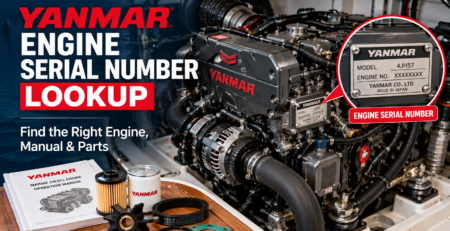
How do I identify my Yanmar engine?
Start with the engine model and serial-number information.
If you’re requesting assistance with a replacement, photographs of the identification plate, engine, gearbox, mounts and engine compartment can also provide useful context.
Final Verdict: Don’t Buy the Horsepower. Buy the Right Propulsion Solution.
After looking at the complete Yanmar range, one thing becomes obvious.
There isn’t one “best” Yanmar marine engine.
There is only the engine that best fits a particular application.
The 9-MHP 1GM10 has a completely different job from the 110-MHP 4JH110.
The 4JH110 has a completely different role from the 250-MHP 4LV250.
And the 4LV250 belongs to a very different propulsion category from a 640-MHP 6LT640.
That’s not a weakness.
That’s the strength of having such a broad engine portfolio.
The challenge is choosing correctly.
So before purchasing a Yanmar marine engine, look beyond the model name.
Check:
Vessel → Application → Horsepower → RPM → Dimensions → Weight → Gearbox/Saildrive → Propeller → Controls → Installation
That is the framework we recommend at Coastal Wave Marine.
If you’re replacing an existing engine, send the current model and serial number, vessel details, drivetrain information and clear installation photographs.
If you’re building a new propulsion system, provide the vessel’s specifications and intended operating profile.
The more accurately the application is defined, the more confidently the appropriate Yanmar marine engine configuration can be evaluated.
And if you’re ready to move from research to purchasing, Coastal Wave Marine can help you evaluate the relevant Yanmar marine engine, marine gearbox, saildrive and related propulsion options for your project.
Because the smartest marine-engine purchase isn’t necessarily the engine with the highest horsepower.
It’s the engine that fits the boat, fits the propulsion system, fits the application and makes sense for the job.
Next Post: Yanmar Marine Engine Troubleshooting: 10 Common Problems, Causes & Fixes
Leave a Reply