
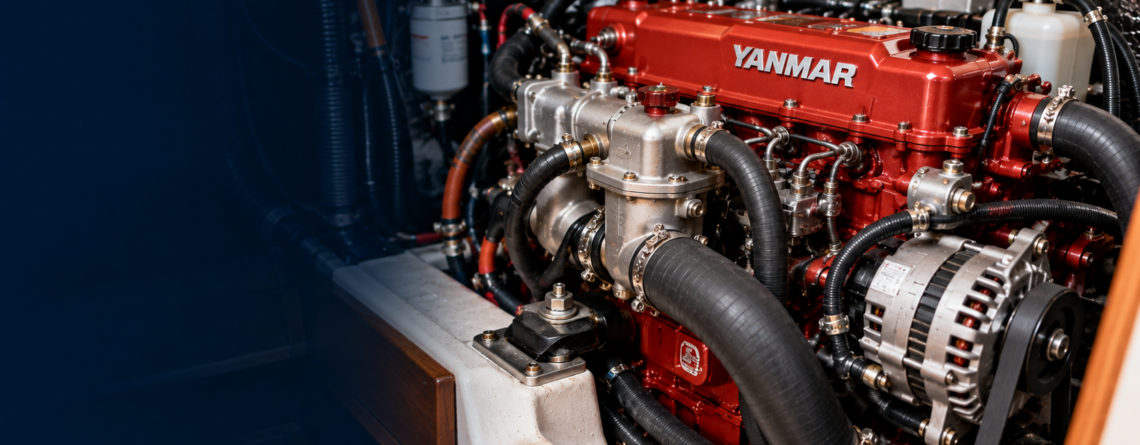
If you own a boat powered by a Yanmar marine diesel engine, knowing how much fuel it consumes is more than a matter of curiosity. It affects how far you can travel, how much you spend on fuel, how you plan longer trips, and whether your engine is operating as expected.
One of the most common questions boat owners ask is: How much diesel does a Yanmar marine engine use per hour?
There is no single answer that applies to every Yanmar engine. A compact auxiliary engine used on a sailing yacht has different fuel requirements from a larger propulsion engine installed in a motorboat. Even two boats with the same engine can record different fuel consumption because of differences in displacement, propeller selection, hull condition, cruising speed, and operating load.
The important thing is to understand what influences fuel consumption and how to interpret the information provided by the manufacturer.
At Coastal Wave Marine, we believe choosing or maintaining a marine engine should involve more than comparing horsepower figures. Boat owners should understand the relationship between engine performance, fuel requirements, vessel characteristics, and long-term operating costs.
This guide explains Yanmar marine engine fuel consumption, how to estimate diesel usage in litres per hour, how RPM and engine load affect fuel demand, and what to investigate when an engine starts consuming more fuel than expected.
Whether you operate a sailing yacht, motorboat, or commercial vessel, understanding these factors can help you make better decisions about your engine and your next trip.
How Much Diesel Does a Yanmar Marine Engine Use Per Hour?
Yanmar marine engine fuel consumption varies according to the engine model and the conditions under which it operates.
The first thing to understand is that fuel consumption is usually expressed in litres per hour (L/h). This measurement tells you how much diesel an engine consumes during one hour of operation under a particular set of conditions.
However, an hourly figure is only useful when you know the engine speed and load associated with it.
For example, an engine operating at a relatively low power demand will generally consume less fuel per hour than the same engine producing substantially more power. The difference can become significant when a boat is travelling at higher speeds, carrying additional weight, or operating against strong currents.
This is why a fuel-consumption figure should never be separated from the conditions under which it was measured.
Yanmar Marine Engine Fuel Consumption Depends on the Model
Yanmar manufactures marine diesel engines for different vessel types and propulsion requirements. Its range includes compact engines for smaller applications and higher-output engines for larger recreational and commercial vessels.
Some of the engine families boat owners may encounter include:
- GM Series: Compact marine diesel engines used in suitable smaller propulsion applications.
- YM Series: Marine diesel engines commonly found in auxiliary sailboat applications.
- JH Series: A range of propulsion engines designed for sailboats and smaller craft.
- 4LV Series: Higher-powered engines for appropriate powerboat applications.
- 8LV Series: V8 marine diesel engines for larger propulsion requirements.
- 6LY Series: Higher-output marine engines.
- 6LF and 6LT Series: Higher-powered engines for demanding marine applications.
These families have different power ratings, engine configurations, and performance characteristics. Their fuel consumption should therefore be evaluated using the specifications for the exact model.
A useful example is Yanmar’s 4JH-CR series. The manufacturer lists the 4JH45 at 45 metric horsepower and 3,000 RPM, while the 4JH57 is rated at 57 metric horsepower and 3,000 RPM. Both engines have published performance information, including fuel-consumption curves.
You can examine the official Yanmar 4JH45 specifications and 4JH57 specifications to see how the manufacturer presents the information.
The important point is that these specifications belong to particular engine models. They should not be used as universal consumption figures for the entire Yanmar range.
For boat owners researching replacement options, Coastal Wave Marine also provides a dedicated selection of Yanmar marine engines.
Why Horsepower Alone Cannot Tell You How Much Diesel an Engine Uses
Horsepower is important, but it does not tell the complete fuel-consumption story.
Two engines with different power ratings may operate at different loads depending on the vessel and its propulsion requirements. Likewise, an engine with a higher rated output does not necessarily consume its maximum possible fuel quantity throughout every trip.
Consider two boats:
- Boat A has a smaller engine that must work relatively hard to maintain its required cruising speed.
- Boat B has a larger engine that can maintain its cruising speed at a lower percentage of its available power.
You cannot determine which boat uses less fuel simply by looking at engine horsepower.
You need to consider the actual power demand, engine performance data, vessel characteristics, and measured fuel consumption.
This is particularly important when selecting a replacement engine. The correct choice should match the boat’s propulsion requirements rather than being based on a fuel-consumption number taken from an unrelated installation.
How to Read a Yanmar Marine Engine Fuel Consumption Curve
One of the most useful resources for understanding Yanmar marine diesel fuel consumption is the manufacturer’s fuel-consumption performance curve.
A performance curve shows how fuel consumption changes as engine speed increases under the stated test and loading conditions.
For example, Yanmar publishes fuel-consumption curves for the 4JH45 and 4JH57. The curves show fuel consumption in litres per hour against engine speed, using a specified propeller-load relationship.
This is more useful than a single isolated figure because it allows readers to understand how fuel demand changes across the engine’s operating range.
What the Horizontal and Vertical Axes Mean
On a typical fuel-consumption curve:
- The horizontal axis represents engine speed in revolutions per minute (RPM).
- The vertical axis represents fuel consumption, commonly expressed in litres per hour.
- The plotted curve shows how fuel consumption changes as engine speed increases.
When reading the curve, make sure you identify the correct engine model and the conditions used to generate the data.
Do not assume that a curve for one engine can be applied to another engine simply because both belong to the same product family.
Why the Propeller-Load Condition Matters
A particularly important detail in Yanmar’s published performance information is the reference to propeller load.
The propeller absorbs power from the engine to produce thrust. As the engine speed increases, the power required by a conventional fixed-pitch propeller can rise substantially.
This means the fuel-consumption curve is not simply a universal statement that every engine will consume a particular quantity of diesel at a particular RPM in every boat.
The actual installation, propeller, and vessel characteristics influence the load placed on the engine.
For a meaningful comparison, use the correct manufacturer’s curve and understand the conditions under which it was produced.
Manufacturer reference: Yanmar 4JH45 and 4JH57 technical specifications and performance curves.
How RPM Affects Yanmar Marine Engine Fuel Consumption
RPM means revolutions per minute. It describes how many times the engine’s crankshaft rotates in one minute.
As engine speed increases, the engine generally produces more power, and fuel demand usually increases. However, the relationship between RPM and fuel consumption depends on the engine design and the load placed on it.
Understanding this relationship helps boat owners avoid making assumptions about fuel efficiency.
Fuel Consumption at Low RPM
At relatively low RPM, an engine generally produces less power and consumes less fuel per hour.
This can be useful during slow manoeuvring, low-speed operation, and situations where the vessel requires limited propulsion power.
However, the lowest possible RPM is not automatically the most appropriate operating speed.
Marine diesel engines are designed to work within specified operating ranges. Consistently operating outside the manufacturer’s recommendations can create problems, depending on the engine and application.
The correct approach is to follow the operating instructions for your particular model rather than choosing an arbitrary low RPM setting to save diesel.
Fuel Consumption at Cruising RPM
Cruising RPM is the engine speed selected to maintain a suitable boat speed under the prevailing conditions.
For many boat owners, this is where fuel efficiency becomes particularly important. You want enough power to maintain a comfortable and practical cruising speed without demanding more output than necessary.
The most economical cruising point is not identical for every boat.
It depends on:
- Engine model and power rating.
- Vessel displacement.
- Hull design and condition.
- Propeller selection.
- Boat speed.
- Weather and sea conditions.
- Engine load.
A useful way to understand your boat is to record its RPM, speed, and fuel consumption at several operating points under reasonably similar conditions.
This allows you to compare how much fuel is being used to achieve different cruising speeds.
Fuel Consumption at High RPM
Higher RPM generally increases fuel consumption because the engine is producing more power.
This is particularly noticeable when a vessel is travelling at higher speeds or operating under heavy propulsion demand.
High RPM may be necessary in certain situations, but prolonged operation should remain within the manufacturer’s recommended limits.
If your boat requires unusually high engine speed or excessive throttle to maintain its normal cruising performance, investigate the cause.
Possible issues include an incorrectly matched propeller, increased hull resistance, excessive vessel loading, or an engine-related problem.
For example, a boat with significant marine growth on its hull may need more propulsion power to maintain the same speed. Simply increasing the throttle may not address the underlying problem.
What Factors Affect Yanmar Marine Engine Fuel Consumption?
Two boats fitted with the same Yanmar engine can record different fuel-consumption figures.
This is because the engine is only one part of the propulsion system. The vessel, propeller, operating conditions, and mechanical condition all influence how much power is required.
Let’s look at the main factors.
1. Engine Model, Horsepower, and Displacement
Engine design and rated output influence how much fuel an engine requires to produce power.
A compact auxiliary engine and a high-output propulsion engine have different power capabilities and intended applications.
When researching Yanmar engine fuel consumption per hour, always identify the complete engine model.
For example, consumption information for a 4JH45 should not automatically be applied to a 4JH57, 4JH80, or 4JH110.
Even where engines share a product family, their rated output and performance characteristics may differ.
2. Boat Size and Displacement
Displacement refers to the weight of the vessel, including its equipment, fuel, passengers, and other loads.
A heavier vessel generally requires more propulsion effort than a lighter vessel with otherwise comparable characteristics.
Additional passengers, equipment, cargo, and stores can change the vessel’s operating weight.
For commercial vessels and boats used for extended trips, this is particularly important because loading conditions may change regularly.
3. Engine RPM and Operating Load
The amount of power demanded from the engine influences fuel consumption.
Operating against a strong current, carrying a heavy load, or travelling through difficult sea conditions may require more propulsion power than operating under favourable conditions.
This is why Yanmar marine engine fuel consumption at different RPMs should be considered alongside boat speed and engine load.
RPM tells you how fast the engine is turning. It does not, by itself, tell you exactly how much power the engine is producing under every installation condition.
4. Propeller Size, Pitch, and Condition
The propeller converts engine power into thrust.
If the propeller is incorrectly selected for the engine and vessel, it may place excessive load on the engine or prevent it from achieving the expected operating performance.
A damaged or fouled propeller can also affect propulsion efficiency.
When investigating unexpected fuel consumption, check that the propeller is suitable for the particular engine, marine gear or saildrive, and vessel configuration.
If the engine cannot achieve the manufacturer’s specified operating range under the correct test conditions, propeller matching and installation should be investigated by a qualified marine professional.
5. Hull Condition and Marine Growth
Barnacles, algae, and other marine growth increase resistance as a boat moves through the water.
A fouled hull can make it harder for the vessel to maintain its usual speed.
The engine may consequently need to produce more power to overcome the additional resistance.
If fuel consumption has gradually increased, inspect the hull and propeller as part of the investigation.
6. Weather, Waves, and Water Conditions
Wind, waves, currents, and water conditions affect how much power a vessel requires.
A boat travelling against a strong current may need more engine output to maintain its speed over the ground.
Likewise, rough water and unfavourable wind conditions can increase resistance and affect fuel requirements.
This is one reason fuel-consumption comparisons should be made under reasonably similar operating conditions.
A change in diesel usage does not automatically mean that the engine has developed a fault.
7. Engine Maintenance and Mechanical Condition
A poorly maintained engine may not perform as expected.
Restricted fuel filters, air-intake problems, injector faults, and other mechanical issues can affect engine operation.
Regular servicing helps maintain the condition of important components and provides opportunities to identify problems before they become more serious.
Follow the correct Yanmar marine engine maintenance schedule for your model.
8. Fuel Quality and Fuel-System Condition
Contaminated fuel, water in the fuel, restricted filtration, and fuel-delivery problems can affect engine performance.
Yanmar’s official marine FAQ advises owners to follow the relevant Operation Manual for fuel requirements and fuel-related precautions. It also advises against using fuel additives unless supported by the applicable manufacturer guidance.
For this reason, avoid treating fuel additives as a universal solution to increased consumption.
If you suspect fuel contamination or a delivery problem, have the system inspected and follow the recommendations for your engine.
How to Calculate Yanmar Marine Engine Fuel Consumption
Understanding the basic fuel-consumption calculation helps you plan trips, monitor operating costs, and compare your engine’s performance over time.
The most important thing is to use accurate measurements.
Calculate Fuel Consumption in Litres Per Hour
The basic formula is:
Fuel consumption (L/h) = Total fuel used (L) ÷ Operating time (hours)
For example, imagine a boat uses 24 litres of diesel during six hours of engine operation.
The calculation is:
24 ÷ 6 = 4 L/h.
The average fuel consumption during that measured period is 4 litres per hour.
This is an illustrative calculation, not a published Yanmar specification.
Also remember that the result represents an average. If the boat spent part of the period travelling slowly and another part operating at higher RPM, the calculation combines those different conditions.
For a more useful comparison, measure fuel usage over separate operating periods with the engine running at reasonably consistent speeds and loads.
Calculate the Fuel Needed for a Boat Trip
Suppose you have measured an average fuel consumption of 5 L/h under the operating conditions you expect.
You plan to operate the engine for seven hours.
The estimated fuel requirement is:
5 × 7 = 35 litres.
This gives you a starting estimate for the planned operating time.
It is not a complete trip-fuel allowance.
You must also account for additional manoeuvring, unexpected delays, changes in sea conditions, and an appropriate fuel reserve.
Never plan a trip around the exact theoretical quantity.
Calculate Fuel Consumption Per Nautical Mile
Litres per hour tells you how much fuel the engine uses over time.
Litres per nautical mile tells you how much fuel is used to travel a particular distance.
The formula is:
Fuel per nautical mile = Fuel consumption (L/h) ÷ Boat speed (knots)
For example, imagine a boat consumes 5 L/h while travelling at 6 knots.
5 ÷ 6 = 0.83 L per nautical mile.
This is another illustrative example.
The measurement can be useful when comparing different cruising speeds because it shows the relationship between fuel use and distance travelled.
However, make sure you use a consistent speed measurement. Speed through the water and speed over the ground can differ when currents are present.
How to Measure Your Boat’s Actual Fuel Consumption
For owners who want a more realistic understanding of their Yanmar engine’s fuel usage, a simple operating log can be valuable.
Record the following information:
| Information | Why it matters |
|---|---|
| Engine model | Identifies the correct manufacturer specifications |
| Operating hours | Establishes the time period being measured |
| RPM | Helps explain changes in engine speed |
| Boat speed | Allows comparison of fuel use against distance |
| Fuel used | Provides the basis for calculating consumption |
| Vessel loading | Helps explain changes in propulsion demand |
| Sea conditions | Provides context for the measurement |
| Maintenance history | Helps identify possible changes in engine condition |
Where an approved fuel-flow monitoring system is installed, it may provide additional information. Make sure the system is suitable for the engine and installed correctly.
A consistent record is much more useful than relying on memory or comparing unrelated fuel receipts.
Why Actual Fuel Consumption May Differ from Yanmar’s Published Figures
Manufacturer specifications provide an important reference, but they should not be mistaken for a guarantee of the fuel consumption every boat will achieve.
Published performance data is produced under stated technical conditions. Actual installations can differ in several ways.
For example:
- The vessel may have a different displacement.
- The propeller may have a different specification.
- The hull may have additional resistance.
- The boat may carry a different load.
- The engine may be operating under different conditions.
- The measurement method may not be identical to the manufacturer’s test method.
Yanmar’s technical information for the 4JH45 and 4JH57 includes fuel-consumption curves based on a stated propeller-load relationship. This is useful because it shows the manufacturer is presenting fuel consumption in relation to engine speed and load assumptions rather than as one universal figure.
When comparing published and measured figures, check that you are comparing the same model, units, operating point, and relevant test conditions.
For additional model-specific information, consult the official Yanmar marine engine product pages.
Why Is Your Yanmar Marine Engine Consuming More Diesel Than Usual?
A noticeable increase in fuel consumption deserves investigation, especially when it occurs alongside changes in engine performance.
The first step is to determine whether the boat is operating under different conditions. Increased loading, rougher water, stronger currents, and a fouled hull can all increase fuel demand.
If those factors have not changed, consider whether the engine or propulsion system needs inspection.
Restricted Fuel Filters
Fuel filters help protect the fuel system from dirt and other contaminants.
A restricted filter can interfere with normal fuel delivery and may contribute to poor engine performance.
Follow the filter inspection and replacement requirements for your engine model.
Dirty or Faulty Fuel Injectors
Injectors deliver fuel into the combustion chambers.
If an injector is not operating correctly, combustion and engine performance may be affected.
Possible symptoms include abnormal exhaust smoke, rough running, reduced power, and changes in fuel consumption.
Injector diagnosis and servicing should be carried out using the appropriate procedures and equipment.
Incorrect Propeller Matching
An incorrectly matched propeller can place an unsuitable load on the engine.
If your boat struggles to reach the specified operating range or requires more throttle than expected, have the propeller and installation checked.
Do not attempt to solve an installation problem simply by operating the engine at higher RPM.
Fouled Hull or Damaged Propeller
Marine growth and propeller damage can increase resistance and reduce propulsion efficiency.
If fuel consumption has increased gradually, inspect these components before assuming that the engine itself is responsible.
Air Intake and Exhaust Restrictions
Engines require suitable airflow and an exhaust system that operates correctly.
Restrictions or faults affecting these systems can influence performance and may produce abnormal symptoms.
Persistent smoke, unusual engine behaviour, and reduced power should be investigated rather than ignored.
Engine Wear and Poor Maintenance
Mechanical wear and neglected maintenance may affect engine performance.
If your engine has accumulated substantial operating hours, review its maintenance history and condition rather than judging it by age or hours alone.
For more guidance, read our Yanmar marine engine troubleshooting guide and our article on common Yanmar marine engine problems.
How to Reduce Yanmar Marine Engine Fuel Consumption
Reducing unnecessary fuel consumption starts with understanding what your engine and vessel actually need.
The goal is not to force the engine to operate at the lowest possible RPM or make changes that compromise its correct operation. It is to maintain the propulsion system and operate the vessel appropriately.
Operate Within the Manufacturer’s Recommended Range
Follow the operating instructions for your particular Yanmar engine.
The appropriate RPM and load depend on the model and application. Avoid assuming that one cruising setting is suitable for every engine.
Maintain the Correct Propeller Setup
The propeller must be appropriate for the engine and vessel.
If you suspect excessive engine loading, have the propeller selection and installation checked against the manufacturer’s requirements.
Keep the Hull and Propeller Clean
Inspect the hull and propeller regularly for marine growth and damage.
Reducing unnecessary resistance can help the vessel maintain its expected performance.
Follow the Correct Maintenance Schedule
Routine servicing is essential for dependable marine engine operation.
Depending on the engine model, its service requirements may include:
- Engine oil and filter replacement.
- Fuel filter inspection and replacement.
- Air-intake inspection.
- Cooling-system checks.
- Belt and hose inspection.
- Fuel-system maintenance.
- Inspection of other specified service components.
Always follow the correct service intervals and specifications in the relevant manual.
Coastal Wave Marine provides a Yanmar marine engine parts guide to help readers understand the importance of identifying suitable components.
Use Appropriate Fuel and Maintain the Fuel System
Use fuel that meets the requirements of your engine.
Keep the fuel system properly maintained and take appropriate precautions against water contamination and dirt entering the tank.
Do not assume that additives will improve fuel economy. Follow Yanmar’s guidance for the particular engine and fuel type.
Monitor Fuel Consumption Over Time
Keeping records of RPM, operating hours, fuel usage, and maintenance activities makes it easier to identify changes.
For example, if your boat consistently uses more fuel at a similar speed and under comparable conditions, investigate whether something has changed in the hull, propeller, engine, or fuel system.
This approach is more reliable than trying random operating adjustments.
Auxiliary vs. Main Propulsion Engines: Why Fuel Requirements Differ
Yanmar engines are used in different types of vessels and propulsion applications.
Understanding the difference between auxiliary and main propulsion engines helps explain why fuel requirements vary.
Fuel Consumption in Auxiliary Sailboat Engines
An auxiliary engine provides propulsion when sailing conditions are unsuitable or when additional manoeuvring power is required.
Typical operating situations include entering and leaving a marina, travelling through areas with limited wind, and motoring when sailing is not practical.
Compact Yanmar engines used in suitable auxiliary applications have different power requirements from engines designed for larger motorboats.
Their fuel consumption should be evaluated using the specifications for the actual model and its installation.
Fuel Consumption in Larger Motorboat Engines
Motorboats may require considerably more propulsion power depending on their size, hull design, speed, and intended use.
Yanmar’s larger engine families are designed for different powerboat applications, with their own rated outputs and performance characteristics.
A larger engine operating under substantial propulsion demand will naturally have different fuel requirements from a smaller auxiliary engine.
This is why comparing engines by litres per hour without considering the work they perform can be misleading.
Choosing the Right Yanmar Engine for Your Boat
When researching a replacement or new marine engine, consider more than its advertised fuel consumption.
Evaluate:
- Required horsepower and power rating.
- Vessel displacement and intended use.
- Required cruising speed.
- Propeller and marine gear compatibility.
- Installation dimensions.
- Cooling-system configuration.
- Maintenance requirements.
- Availability of appropriate parts and service support.
The correct engine should suit the vessel and its propulsion requirements.
Boat owners researching replacement options can explore the Yanmar marine engines available through Coastal Wave Marine.
How Much Fuel Should You Carry for a Yanmar-Powered Boat?
Fuel planning is an important part of responsible boating.
Knowing your average hourly fuel consumption gives you a starting point, but you must also estimate how long the engine will operate during the trip.
For example, if your measured average consumption is 6 L/h and you expect to operate the engine for five hours, your initial calculation is:
6 × 5 = 30 litres.
That figure represents the estimated fuel for the planned operating time only.
Your complete fuel plan should account for:
- Additional manoeuvring time.
- Changes in wind, waves, and currents.
- Unexpected delays.
- Changes in cruising speed.
- The usable capacity of the fuel tank.
- A suitable reserve under applicable boating safety guidance.
Do not assume that every litre stated as tank capacity is necessarily available for normal engine operation.
It is also sensible to review fuel consumption after trips. Comparing estimated fuel use with actual usage can help improve future planning.

When Should You Inspect, Repair, or Replace a Yanmar Marine Engine?
Higher fuel consumption does not automatically mean that an engine needs replacing.
In some cases, the cause may be a restricted filter, incorrect propeller selection, hull fouling, or another issue that can be investigated and corrected.
The important thing is to identify the underlying problem before making an expensive decision.
When Increased Fuel Consumption Is a Maintenance Issue
If the engine has not been serviced according to its recommended schedule, review its maintenance history.
Check the condition of the filters, fuel system, air intake, cooling system, and other relevant components.
A qualified marine technician can determine whether the problem is related to routine maintenance or a more serious mechanical fault.
When Professional Engine Diagnosis Is Necessary
Arrange an inspection if increased fuel consumption occurs alongside symptoms such as:
- Persistent abnormal exhaust smoke.
- Unusual engine noise or vibration.
- Reduced power.
- Difficult starting.
- Abnormal operating temperatures.
- Fuel leaks.
- Unexpected changes in engine performance.
These symptoms should not be ignored, particularly when several appear together.
When Replacement May Be Worth Considering
If an engine has significant wear, repeated mechanical problems, or repair requirements that are becoming difficult to justify, replacement may be worth evaluating.
However, the decision should consider the engine’s actual condition, service history, operating hours, repair costs, vessel requirements, and available replacement options.
It should not be based on fuel consumption alone.
For customers considering a replacement, Coastal Wave Marine‘s Yanmar marine engine range provides a starting point for exploring available options.
Frequently Asked Questions About Yanmar Marine Engine Fuel Consumption
1. How much diesel does a Yanmar marine engine use per hour?
It depends on the engine model, RPM, power demand, propeller, vessel displacement, and operating conditions. Use the manufacturer’s fuel-consumption curve for your exact engine to obtain a relevant reference.
2. Which Yanmar marine engine is the most fuel-efficient?
There is no single most fuel-efficient model for every vessel. Fuel efficiency depends on the engine’s application and how well it matches the boat. Compare model-specific performance information at the power output relevant to your vessel.
3. How much fuel does a Yanmar diesel engine use at cruising RPM?
The amount varies according to the engine model and the load placed on it. Consult the relevant manufacturer performance curve and compare it with measured fuel consumption at your boat’s cruising speed.
4. Does running a Yanmar engine at lower RPM save fuel?
Lower RPM generally reduces hourly fuel consumption because the engine produces less power. However, the lowest possible RPM is not automatically the best operating point. Follow the operating recommendations for your engine.
5. Why is my Yanmar marine engine using more diesel than usual?
Possible causes include increased vessel loading, rougher conditions, hull fouling, propeller problems, restricted fuel filters, injector faults, and other mechanical issues. Compare operating conditions before deciding that the engine has developed a fault.
6. How do I calculate Yanmar marine engine fuel consumption per nautical mile?
Divide fuel consumption in litres per hour by boat speed in knots. For example, 5 L/h at 6 knots equals approximately 0.83 litres per nautical mile.
7. Does propeller size affect Yanmar marine engine fuel consumption?
Yes. Incorrect propeller selection or damage can affect engine loading and propulsion efficiency. Have the propeller checked against the requirements for your engine and vessel.
8. Can poor engine maintenance increase diesel consumption?
Yes. Certain maintenance problems, including restricted filters and fuel-system faults, can affect engine performance and potentially increase fuel consumption. Follow the service schedule for your particular engine.
9. How much fuel should I carry for a long boat trip?
Estimate your operating hours and multiply them by a realistic fuel-consumption figure based on your vessel’s performance. Then account for additional operating time, changing conditions, and an appropriate reserve.
10. Where can I find official Yanmar fuel-consumption specifications?
Start with the official Yanmar product page and technical documentation for your exact model. Some specification sheets include fuel-consumption curves showing how fuel usage changes with engine speed and propeller load.
Conclusion: Understand Your Yanmar Marine Engine’s Fuel Consumption Before Your Next Trip
Understanding Yanmar marine engine fuel consumption helps you make more informed decisions about engine operation, fuel planning, maintenance, and replacement.
The most important thing to remember is that there is no single fuel-consumption figure that applies to every Yanmar marine engine. Model specifications, engine speed, operating load, vessel displacement, propeller selection, hull condition, and mechanical maintenance all influence the amount of diesel your boat uses.
Start with the manufacturer’s performance information for your exact engine model. Then compare those figures with your own operating records under similar conditions.
If you are researching a replacement engine, comparing propulsion options, or looking for suitable Yanmar components, Coastal Wave Marine can help you explore the available range.
Browse our Yanmar marine engine collection or contact Coastal Wave Marine for assistance with your marine engine requirements.
Next Post: How Long Do Yanmar Marine Engines Last? Lifespan, Hours & Tips
Leave a Reply