
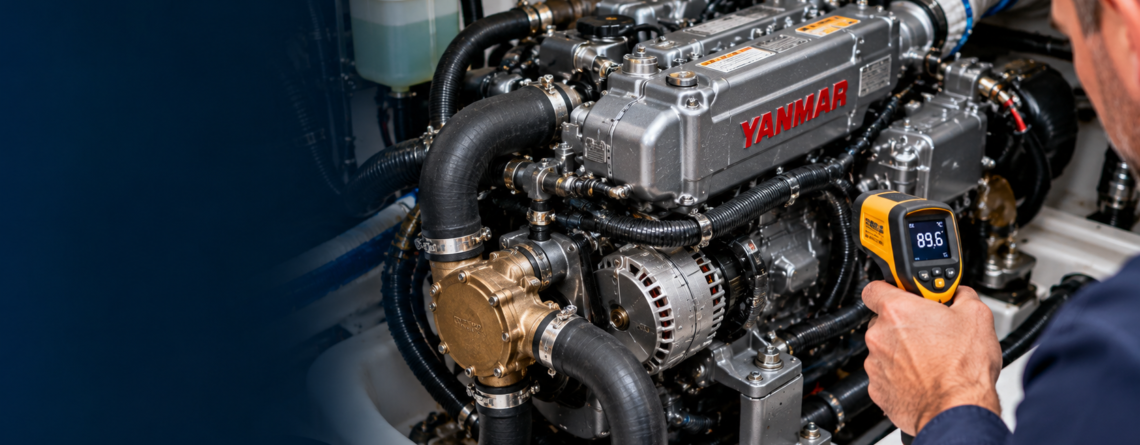
A Yanmar marine diesel engine that starts running hotter than normal deserves immediate attention. You might notice the temperature gauge climbing while cruising, hear a high-temperature alarm, or discover that the cooling-water discharge has changed. Whatever the symptom, ignoring it can turn a relatively straightforward repair into a much more expensive engine problem.
The good news is that Yanmar marine engine overheating does not automatically mean the engine needs rebuilding or replacing. The underlying issue could involve a restricted seawater intake, a worn impeller, a cooling-system restriction, a thermostat, low coolant, or another component that requires investigation.
The challenge is identifying the actual cause rather than guessing and replacing parts unnecessarily.
At Coastal Wave Marine, we help customers navigate marine-engine equipment and replacement-part requirements. Understanding the engine model, recognizing the symptoms, and confirming component compatibility are important steps when sourcing the right products for a repair.
This guide explains 10 common causes of Yanmar marine engine overheating, the warning signs to watch for, troubleshooting considerations, and how to identify the appropriate replacement parts.
Important safety warning: If your engine displays a high-temperature alarm or shows signs of overheating, follow the vessel’s safety procedures and stop the engine as soon as it is safe to do so. Never open a hot, pressurized cooling system. Allow the engine to cool completely before inspecting coolant levels, and consult the operation manual for your specific model before performing maintenance.
What to Do First When Your Yanmar Marine Engine Overheats
Before investigating individual components, address the immediate situation. Continuing to operate an overheating engine can increase the risk of damage to internal components, seals, and other engine systems.
1. Reduce the load and stop safely
Follow your vessel’s operating procedures and reduce engine load where appropriate. Stop the engine as soon as it is safe to do so, particularly if a high-temperature alarm activates or the temperature rises beyond its normal operating range.
Do not increase RPM in an attempt to force more cooling water through the system, and do not continue running the engine simply to reproduce the problem.
2. Allow the engine to cool
Hot coolant can remain under pressure. Opening a pressurized cap while the engine is hot can release scalding liquid or steam.
Wait until the engine has cooled completely before inspecting the coolant system. Follow the manufacturer’s instructions for checking levels and inspecting components.
3. Record the symptoms
The circumstances surrounding the overheating can help narrow down the possible causes.
Consider the following questions:
- Did the temperature rise suddenly or gradually?
- Was the engine operating at high RPM, under heavy load, or at idle?
- Was cooling-water discharge reduced or absent?
- Did the problem begin after maintenance or a period of storage?
- Is there visible coolant leakage?
- Did an alarm or diagnostic code appear?
- Has the engine overheated previously?
These observations are useful diagnostic clues, but they do not establish a confirmed fault on their own.
Understanding Yanmar Marine Engine Cooling Systems
Not every Yanmar marine engine uses the same cooling arrangement. Engine model, generation, and installation determine which components are present and how the system should be serviced.
Raw-water cooling
A raw-water circuit draws water from outside the vessel. Depending on the engine and installation, water may pass through an intake, seacock, strainer, seawater pump, cooling passages, and exhaust system before being discharged.
A restriction or component failure in this circuit can reduce cooling-water flow.
Heat-exchanger cooling
Some Yanmar engines use a heat exchanger and a closed engine-coolant circuit.
In this arrangement, engine coolant circulates through the engine while seawater passes through a separate circuit. The heat exchanger transfers heat from the coolant to the seawater.
An engine using this arrangement may therefore have two areas to investigate: the raw-water circuit and the closed coolant circuit.
Why the exact model matters
Cooling-system layouts, thermostat arrangements, pump specifications, coolant requirements, and service procedures vary across Yanmar engine families.
Before ordering replacement components, identify the engine and consult its applicable operation or service documentation. Coastal Wave Marine’s Yanmar marine engine category is a useful starting point when researching available engines and model families.
10 Common Causes of Yanmar Marine Engine Overheating
The following are possible causes, not a universal diagnosis. The correct checks depend on the engine’s design, symptoms, and maintenance history.
1. Blocked Raw-Water Intake or Seacock
An engine cannot remove heat effectively if its cooling system does not receive the required supply of seawater.
Marine growth, debris, an obstructed intake, a clogged strainer, or an incorrectly positioned seacock can restrict water flow. This is one reason intake and water-supply checks are important when investigating why a Yanmar marine diesel engine is overheating.
Warning signs
- The temperature rises above its normal operating range.
- Cooling-water discharge decreases or stops, where visible discharge is part of the installation.
- The problem begins after the vessel has been sitting in the water.
- The engine overheats despite having operated normally previously.
What should you check?
After the engine has been stopped and the situation is safe, inspect accessible intake components according to the vessel’s procedures. Check the seacock position and examine the strainer if one is fitted.
Do not attempt to clear an intake while the engine is running or place your hands near moving machinery.
How is it fixed?
A confirmed obstruction must be removed safely, and damaged or malfunctioning intake components must be repaired. If the seacock is difficult to operate or the restriction persists, obtain qualified assistance.
Before buying a replacement pump, establish whether the engine is receiving an adequate supply of cooling water.
2. A Damaged or Worn Seawater Pump Impeller
The seawater pump impeller is an important component in engines equipped with this type of cooling pump. Its flexible blades move water through the pump, helping supply the cooling system.
Over time, impeller blades can wear, crack, or become damaged. Inadequate water supply or operating the pump without sufficient water can also cause damage, depending on the circumstances.
Warning signs
- Reduced cooling-water discharge
- An overheating alarm
- A history of dry running or cooling-system maintenance
- Overheating after an extended period of storage
- Cracked, worn, or missing impeller blades discovered during inspection
These symptoms can indicate an impeller problem, but they do not prove it is the only possible cause.
What should you check?
Follow the inspection procedure in the operation or service manual for your exact engine. The Yanmar YM Series Operation Manual illustrates how impeller condition and the seawater pump should be inspected, but its procedures should only be applied to the appropriate engine series.
If blades are missing, investigate whether fragments may remain in the downstream cooling passages.
How is it fixed?
Replace a damaged impeller or one that has reached its specified service interval. Confirm the correct impeller specification and installation procedure before beginning work.
Yanmar’s YM Series operation manual provides model-specific maintenance guidance. Impeller service intervals vary across engine families, so do not apply an interval from another series without checking your own manual.
If an impeller fault is confirmed, explore the appropriate Yanmar marine engine impeller replacement options and verify compatibility with the installed pump.
3. A Worn or Damaged Seawater Pump
An impeller can be in acceptable condition while another part of the pump prevents adequate water circulation.
Depending on the pump design, problems may involve internal wear, damaged surfaces, seals, shaft components, drive issues, or air entering the suction side.
Warning signs
- Overheating continues after an impeller has been inspected or replaced.
- There is visible leakage around the pump.
- The pump produces unusual noise.
- Cooling-water discharge remains inadequate.
- The engine has recurring cooling-system problems.
What should you check?
Inspect the pump and its connections according to the applicable service procedure. Check for visible damage, leaks, and drive problems.
A pump should not be condemned simply because the engine is overheating. Intake restrictions and other cooling-system faults can produce similar symptoms.
How is it fixed?
If testing confirms that the pump is worn or damaged, repair or replace the affected components as appropriate. Internal pump work may require professional assistance.
When sourcing Yanmar marine seawater pump parts, verify the complete engine model, serial number, and pump configuration before ordering.
4. A Clogged Heat Exchanger or Restricted Cooling Passages
On engines fitted with a heat exchanger, internal deposits, contamination, corrosion, or restricted passages can interfere with heat transfer.
The result may be reduced cooling performance even when water appears to be moving through part of the system.
Warning signs
- Persistent overheating
- Cooling performance that has gradually deteriorated
- A problem that remains after basic water-supply checks
- Deposits or contamination discovered during inspection
What should you check?
A technician may need to assess both the seawater and coolant sides of the exchanger. Normal-looking water discharge does not necessarily prove that the complete cooling system is operating correctly.
How is it fixed?
The appropriate repair depends on the type and severity of the restriction. Cleaning, servicing, or replacing the exchanger may be necessary after diagnosis.
Use only cleaning procedures and products compatible with the exchanger’s materials and the manufacturer’s instructions.
If replacement is required, confirm that the proposed Yanmar marine heat exchanger matches the engine and installed cooling arrangement.
5. A Faulty Thermostat
A thermostat helps regulate engine temperature by controlling coolant flow according to the system’s design. If it fails to operate correctly, the engine may not regulate temperature as intended.
The effect depends on the particular thermostat and how it has failed.
Warning signs
- Temperature remains above the specified range.
- Overheating continues despite apparently adequate water supply.
- Temperature behavior changes after cooling-system maintenance.
- Other initial checks do not identify the cause.
What should you check?
Confirm that the engine is genuinely overheating rather than displaying an incorrect temperature reading. Follow the manufacturer’s procedure for evaluating the thermostat and related components.
How is it fixed?
Replace the thermostat if testing confirms a fault. Use the correct specification for the engine.
Do not permanently remove the thermostat as a shortcut. It is part of the intended temperature-regulation system, and removing it is not a universal solution.
A confirmed thermostat fault may require a Yanmar marine engine thermostat replacement, but compatibility should be verified before purchasing the component.
6. Low Coolant or a Coolant Leak
This cause applies to engines with a closed coolant circuit. It should not be assumed that every Yanmar engine uses the same arrangement.
Low coolant can reduce the system’s ability to transfer heat. A leak may occur at a hose, connection, seal, heat exchanger, or another component.
Warning signs
- The coolant level repeatedly drops.
- There is visible leakage or dried coolant residue.
- The engine triggers a high-temperature alarm.
- Coolant appears where it should not.
- Overheating returns after the coolant is topped up.
What should you check?
After the engine has cooled completely, check the coolant level and inspect accessible hoses and connections according to the manual.
If coolant keeps disappearing, investigate why. Repeatedly topping up the system without finding the cause can delay the necessary repair.
How is it fixed?
Repair the confirmed leak, restore the coolant level using the specified product and procedure, and investigate any suspected internal leakage.
Yanmar’s official marine FAQ directs owners to model-specific documentation and authorized service support for technical questions. Coolant specifications and service procedures must be verified for the particular engine.
7. A Circulation Pump, Belt, or Drive Problem
Some cooling systems use a separate coolant circulation pump, and some installations include belts or other drive components that must operate correctly.
A failed pump, damaged belt, slipping drive, or related mechanical fault may interfere with circulation.
Warning signs
- Overheating accompanied by visible belt damage
- Coolant leakage
- Unusual mechanical noise
- A persistent temperature problem despite adequate raw-water supply
- Visible damage to a pump or drive component
What should you check?
With the engine stopped, inspect accessible components for obvious damage or leakage. Do not reach near a moving belt or attempt adjustments while the engine is running.
The relevant checks depend on the engine’s design.
How is it fixed?
Repair or replace the component confirmed to be faulty. If the pump drive or circulation system needs adjustment, follow the service manual or obtain qualified assistance.
Replacing the impeller alone will not correct a separate circulation-pump or drive fault.
8. A Restricted Exhaust or Water-Discharge Passage
On installations with a wet exhaust, cooling water is routed through portions of the exhaust system before being discharged.
A restriction in the exhaust or water passage can interfere with normal operation and may contribute to overheating or other engine problems.
Warning signs
- Abnormal cooling-water discharge
- Unusual exhaust behavior
- Persistent overheating
- Corrosion, deposits, or deterioration
- Cooling problems that remain after initial checks
What should you check?
Inspect the relevant exhaust and water-discharge components according to the manufacturer’s procedures. A marine technician may need to evaluate the exhaust mixing elbow or related passages.
How is it fixed?
The repair depends on the component’s condition and the confirmed cause. Cleaning or replacement may be appropriate after inspection.
Do not assume that every Yanmar engine uses the same wet-exhaust arrangement or that a restricted exhaust is necessarily responsible for the overheating.

9. Air in the Cooling Circuit or Incorrect Coolant Service
On engines with a closed coolant circuit, trapped air or an incorrect filling procedure following maintenance can interfere with circulation.
An incorrect coolant specification or mixture may also reduce cooling performance or create other problems.
Warning signs
- Overheating after a coolant change
- Repeated coolant-level changes
- Leakage following maintenance
- Temperature fluctuations
- Problems that began after cooling-system components were replaced
What should you check?
Review the work recently performed and verify that the correct coolant was used. Check the coolant level only after the engine has cooled completely.
If air may be trapped in the circuit, follow the specific filling and bleeding procedure for your engine. Procedures can differ between models.
How is it fixed?
Correct the filling procedure or coolant mixture if a problem is confirmed. If overheating or coolant loss continues, investigate the underlying fault rather than repeatedly topping up the system.
10. Excessive Engine Load or Another Underlying Fault
Sometimes, the cooling system is not the only area that needs investigation.
An engine may run hotter under certain operating conditions if the load exceeds what the system can manage, or if another mechanical problem affects normal operation. The possible causes depend on the vessel, engine, propulsion arrangement, and installation.
Warning signs
- Temperature rises mainly under heavy load.
- Engine performance has changed.
- The vessel struggles to reach its usual operating conditions.
- Overheating occurs alongside other unusual symptoms.
- Basic cooling-system checks do not identify the cause.
What should you check?
Record the operating conditions under which the problem occurred. Consider recent changes to the vessel, propulsion system, installation, or maintenance history.
Depending on the application, a marine technician may need to evaluate operating load, propulsion components, exhaust arrangements, and other engine systems.
How is it fixed?
Correct the underlying fault once it has been identified. Do not assume that a replacement engine, new impeller, or different cooling component will solve the problem without proper diagnosis.
For boat owners considering a replacement, the engine’s specifications, vessel requirements, installation constraints, and compatible marine gear or saildrive all matter.
Yanmar Marine Engine Overheating at High RPM
If your Yanmar engine overheats at high RPM, note when the temperature begins to rise and what the engine is doing at that time.
An engine that operates within its normal temperature range at low load but overheats during harder operation may have a cooling system that cannot keep up with the heat being generated. However, this pattern does not identify a single failed component.
Possible areas to investigate include:
- Restricted raw-water intake
- A worn impeller or damaged pump
- Restricted heat-exchanger passages
- A coolant circulation problem
- Excessive operating load
- Another model-specific fault
Do not continue running the engine to reproduce the problem. Record the symptoms and have the cause investigated.
Yanmar Marine Engine Overheating at Idle
What if your Yanmar engine overheats at idle but appears to run cooler under different conditions?
That symptom also needs investigation. Possible causes include restricted water flow, a pump or circulation problem, a thermostat fault, or another issue in the cooling system.
Start by responding safely to the overheating condition. Then record the symptoms, identify the engine, and follow the correct diagnostic procedure.
Raising the RPM is not a repair. If the engine is overheating, stop it safely and investigate the cause before returning it to service.
Warning Signs of Yanmar Marine Engine Overheating
Recognizing an abnormal temperature early can help you avoid more serious damage.
Watch for:
- A temperature gauge rising above its normal range
- A high-temperature alarm
- Reduced or abnormal cooling-water discharge
- Visible coolant leakage on applicable systems
- Steam or unusual heat
- Unexpected changes in engine performance
- Repeated overheating under similar operating conditions
One symptom can have several possible explanations. For example, reduced discharge may indicate a water-supply or pump problem, but it does not prove that the impeller has failed.
If your engine has electronic monitoring, record any diagnostic trouble code. Yanmar explains that electronically controlled engines can display diagnostic codes and recommends consulting the relevant operation manual or an authorized dealer when the available documentation does not resolve the issue.
How to Troubleshoot a Yanmar Marine Engine That Is Running Hot
A structured approach can help you avoid unnecessary parts purchases and missed faults.
Step 1: Record the symptoms
Note the temperature indication, alarms, engine load, water discharge, visible leakage, and recent maintenance.
Step 2: Identify the engine
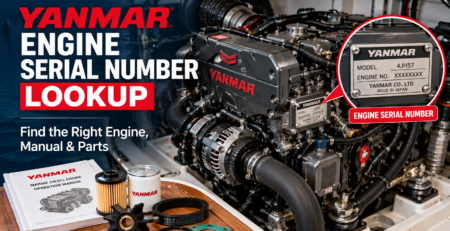
Record the complete model and serial number. These details help establish which components and service procedures apply.
Step 3: Consult the correct manual
Use the manufacturer’s operation and maintenance instructions for the exact engine. Do not rely on a generic procedure when the model-specific instructions are available.
Step 4: Verify the suspected fault
Inspect or test the relevant components according to the manual. If the problem persists, seek qualified assistance rather than continuing to replace parts based on guesswork.
Step 5: Confirm replacement-part compatibility
Verify the component against the engine’s identification details and the applicable parts information before ordering.
Why the Yanmar Engine Model and Serial Number Matter
A description such as “Yanmar diesel engine” is not enough to identify every component needed for a repair.
Different models and configurations can use different pumps, thermostats, heat exchangers, hoses, seals, and maintenance procedures.
Before ordering a replacement, collect:
- Complete engine model
- Engine serial number
- Existing part number, if available
- Photographs of the identification plate and relevant component
- Description of the overheating symptoms
- Information about recent maintenance
- Marine gear or saildrive details, where relevant
Yanmar’s official marine FAQ explains that operation manuals are available by model for currently offered engines, while owners of non-current engines should contact their local dealer or regional distributor. The FAQ also directs owners to dealers for parts lists and parts information.
For further guidance, visit Coastal Wave Marine’s Yanmar marine engine serial number lookup guide.
Finding the Right Yanmar Marine Engine Parts
Once the fault has been confirmed, the next step is identifying the component that needs attention.
Depending on the engine and diagnosis, relevant parts may include:
- Yanmar marine engine impellers
- Seawater pumps and related components
- Thermostats
- Heat-exchanger components
- Hoses, seals, and gaskets
- Belts
- Coolant-service components
- Model-specific maintenance kits
Not every overheating problem requires a replacement part. An obstruction, incorrect service procedure, or another underlying issue may be responsible.
When a replacement is necessary, verify the component against the engine’s model, serial number, and applicable parts information.
Yanmar explains that its Genuine Parts are designed for Yanmar engines and directs owners to its dealer network for parts support. You can read more on the official Yanmar Marine Service & Parts page.
For Coastal Wave Marine customers, the most useful next step is to review the Yanmar marine engine parts guide and the relevant Yanmar marine engine category.
The purchasing process should be straightforward: identify the engine, diagnose the problem, verify the required component, confirm compatibility, and then request a quote or order the appropriate part.
How to Prevent Yanmar Marine Engine Overheating
You cannot prevent every cooling-system failure, but regular maintenance can help identify developing problems.
Follow the model-specific maintenance schedule
Use the intervals specified for your engine. Do not automatically apply an interval from another Yanmar series.
Monitor cooling-water discharge
Follow the manufacturer’s instructions for checking seawater discharge and investigating changes. Reduced discharge can be an important warning sign, but it must be interpreted alongside the other symptoms.
Maintain the seawater pump and impeller
Inspect or replace the impeller according to the applicable maintenance schedule. Investigate damaged components and ensure that servicing is completed using the correct procedure.
Check coolant where applicable
Monitor coolant levels and follow the specified coolant requirements and replacement intervals for your engine.
Investigate changes promptly
If the temperature begins to rise, discharge changes, or an alarm activates, do not ignore it. Respond safely and establish the cause before returning the engine to service.
Coastal Wave Marine’s Yanmar marine engine maintenance schedule guide provides a useful next step for owners reviewing their maintenance requirements.

When Should You Call a Marine Technician?
Some basic checks may be appropriate for a knowledgeable owner when performed safely and according to the manual. Other procedures require specialized tools, testing, or technical experience.
Seek professional assistance if:
- The engine continues to overheat after initial checks.
- A pump or heat exchanger needs internal inspection.
- Coolant repeatedly disappears.
- You suspect an internal engine fault.
- The temperature reading appears inconsistent with the engine’s behavior.
- The engine has experienced severe overheating.
- You are unsure how to inspect or service the cooling system.
Yanmar recommends consulting its dealer network for technical assistance when the available documentation does not resolve an engine problem. You can find guidance through the official Yanmar Marine FAQ.
If you need help identifying an engine or determining which replacement components to investigate, contact Coastal Wave Marine with the model, serial number, and details of the symptoms.
Frequently Asked Questions About Yanmar Marine Engine Overheating
Why is my Yanmar marine engine overheating?
Possible causes include a blocked seawater intake, restricted cooling-water flow, a damaged impeller, a worn pump, a clogged heat exchanger, a thermostat fault, low coolant on applicable systems, or another engine-specific problem. The correct diagnosis depends on the model and symptoms.
Can a bad impeller cause a Yanmar engine to overheat?
Yes. A damaged or worn seawater-pump impeller can reduce cooling-water flow on engines that use this arrangement. Other restrictions and pump problems can produce similar symptoms, so confirm the fault before replacing the impeller.
Why does my Yanmar engine overheat at high RPM?
Overheating at high RPM can indicate that cooling performance is insufficient under the operating conditions, but it does not identify one specific cause. Restricted water flow, pump problems, heat-exchanger restrictions, excessive load, and other faults may need investigation.
Why does my Yanmar engine overheat at idle?
Possible causes include restricted cooling-water flow, a pump or circulation problem, a thermostat fault, or another cooling-system issue. Record the symptoms and follow the troubleshooting procedure for your engine rather than assuming the impeller is responsible.
Can a clogged heat exchanger cause overheating?
Yes. On engines equipped with a heat exchanger, restricted passages can reduce heat-transfer performance. The exchanger should be inspected and serviced according to the manufacturer’s procedures.
Can low coolant cause a Yanmar marine engine to overheat?
Yes, on engines with a closed coolant circuit, low coolant can interfere with heat transfer. Investigate why the level has dropped, and never open a hot, pressurized cooling system.
Should I continue running a Yanmar engine with a high-temperature alarm?
Do not continue operating the engine simply to see whether the temperature stabilizes. Follow the vessel’s safety procedures and stop it as soon as it is safe to do so. Investigate the cause before restarting.
How do I find the right Yanmar cooling-system parts?
Record the complete engine model and serial number, identify the suspected fault, and verify the required part against the applicable parts information. A photograph alone may not establish compatibility.
Where can I find the correct Yanmar marine engine manual?
Yanmar provides operation manuals for currently offered engines through their model-specific product pages. For non-current engines, consult your local dealer or regional distributor. See the official Yanmar Marine FAQ.
Does every Yanmar marine engine use a heat exchanger?
No. Cooling arrangements vary by engine model and configuration. Identify the engine before assuming which components it uses or applying a particular troubleshooting procedure.
Final Thoughts: Diagnose the Cooling Problem Before Replacing Parts
When Yanmar marine engine overheating occurs, take the warning seriously, stop the engine safely, and identify the underlying cause.
Start by recording the symptoms and identifying the engine. Then investigate the appropriate cooling system, follow the model-specific manual, and confirm the fault before purchasing replacement components.
If the problem involves an impeller, seawater pump, thermostat, heat exchanger, hose, or another serviceable component, accurate identification will help you source the appropriate replacement.
At Coastal Wave Marine, our goal is to help customers navigate marine-engine equipment and replacement-part requirements. Whether you are researching Yanmar marine engine parts, reviewing maintenance requirements, or considering a replacement engine, begin with the exact model and reliable technical information.
An overheating engine is a warning, not a diagnosis. Understanding the difference can help you avoid unnecessary purchases, make better repair decisions, and protect your investment in your boat.
Next Post: Yanmar Engine Won’t Start? 10 Causes, Fixes & Troubleshooting Steps
Leave a Reply