
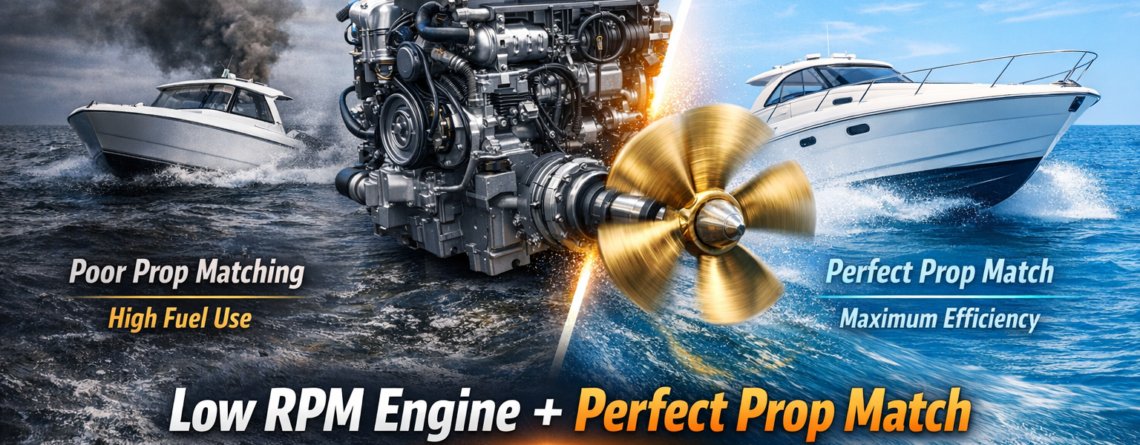
If there is one mistake I see repeatedly after years of supplying and configuring marine engines, it is this: boat owners focus on horsepower, but ignore prop matching.
And that mistake is expensive.
At Coastal Wave Marine, we regularly work with customers who already invested in quality engines but still struggle with poor fuel efficiency, slow cruising speed, or unnecessary engine strain. In most of those cases, the issue is not the engine itself. It is how the engine and propeller interact under load.
Understanding how a low rpm marine inboard diesel engine for prop matching works is what separates an average-performing vessel from one that runs efficiently, reliably, and smoothly over the long term.
This guide is based on real-world configurations, not theory. It will show you exactly how to improve fuel efficiency and speed by matching your engine and propeller correctly.
What Is a Low RPM Marine Inboard Diesel Engine for Prop Matching?
A low RPM marine diesel engine is designed to produce high torque at relatively low engine speeds. Unlike high-revving gasoline engines, these engines operate efficiently under load, making them ideal for heavy vessels and long-distance operation.
Prop matching, on the other hand, is the process of selecting a propeller that allows the engine to operate within its optimal RPM range while delivering the required thrust.
In practical terms, this means:
- The engine must reach its rated RPM under load
- The propeller must absorb the engine’s torque without overloading it
- The system must remain stable across different operating conditions
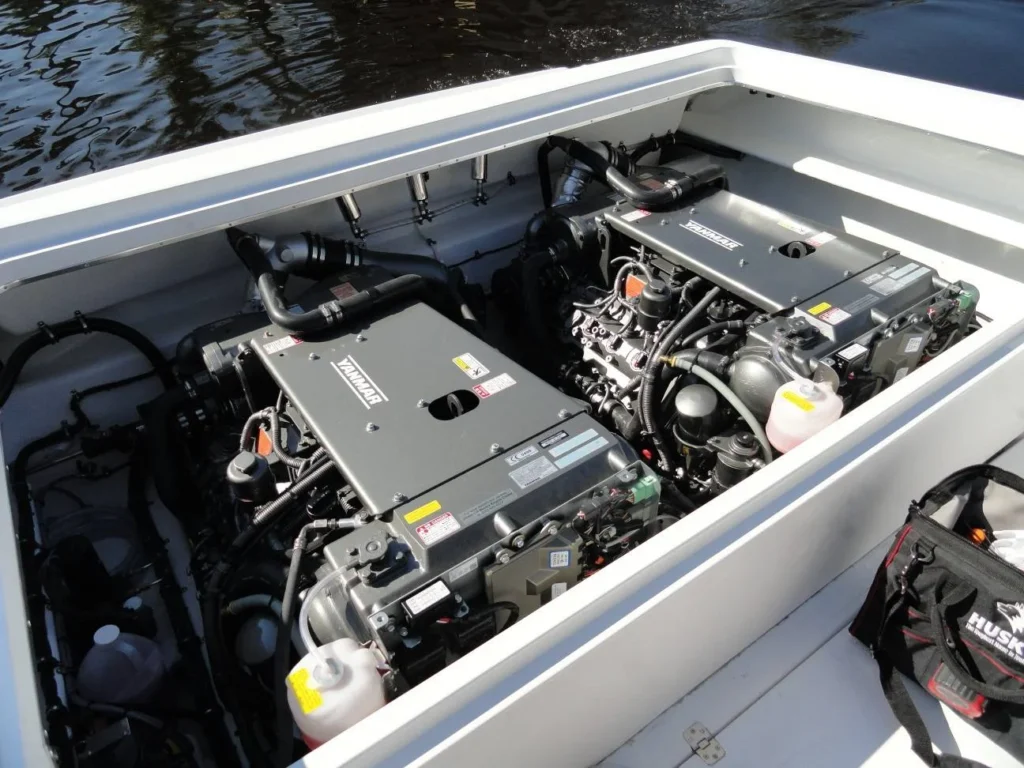
From direct field experience, when a low rpm marine inboard diesel engine for prop matching is correctly configured, you immediately notice smoother throttle response, reduced vibration, and improved fuel economy. You can learn more on how marine diesel engines work.
Why Prop Matching Matters More Than Most Boat Owners Realize
We recently worked with a vessel running a mid-sized diesel engine that consistently failed to reach its rated RPM. The owner assumed the engine was underpowered.
After a full inspection, we identified that the propeller pitch was too aggressive for the engine’s torque output.
Once we corrected the prop specifications:
- Engine RPM increased to the correct operating range
- Fuel consumption dropped by a measurable margin
- Engine temperature stabilized under load
No engine replacement was required.
This is a common scenario. Many performance issues attributed to the engine are actually caused by improper matching.
A properly configured low rpm marine inboard diesel engine for prop matching delivers:
- Efficient fuel burn at cruising speed
- Reduced internal engine stress
- Improved propulsion efficiency
- Longer service intervals
The #1 Trick for Better Fuel Efficiency and Speed
The most important principle is this:
Match the engine’s torque curve to the propeller load.
Low RPM diesel engines generate peak torque at lower speeds. If the propeller is too large or has excessive pitch, it overloads the engine. If it is too small, the engine runs inefficiently and wastes energy.
In real-world terms, the goal is simple:
The engine should reach its rated RPM at full throttle under normal load conditions.
If it cannot, the propeller is too demanding. If it exceeds the recommended range, the propeller is too light.
This is the foundation of low rpm marine inboard diesel engine for prop matching for fuel efficiency and speed, and it is where most setups fail. Read more about factors affecting fuel efficiency in engines.
How Improper Matching Affects Your Boat
When the system is not balanced, the consequences are predictable:
- Engine overload, leading to premature wear
- Increased fuel consumption due to inefficient combustion
- Poor acceleration and reduced top speed
- Long-term mechanical stress on internal components
In many cases, operators do not notice these issues immediately. However, over time, the cost becomes evident through higher fuel bills and reduced engine lifespan.
How to Choose the Right Low RPM Marine Inboard Diesel Engine for Prop Matching
Selecting the correct engine requires more than comparing horsepower ratings.
In practice, we evaluate:
- Vessel displacement and hull design
- Operating conditions (coastal, offshore, commercial use)
- Target cruising speed
- Load consistency
For heavier vessels, torque becomes more important than peak speed. This is why a low rpm marine inboard diesel engine for prop matching for fishing boats is often the preferred solution in commercial and recreational fishing applications.
Best Engine Types for Prop Matching Efficiency
Based on consistent field performance, the following engines are widely used for reliable prop matching:
These engines are engineered to deliver stable torque output, making them suitable for best low rpm marine diesel engine for prop matching configurations.
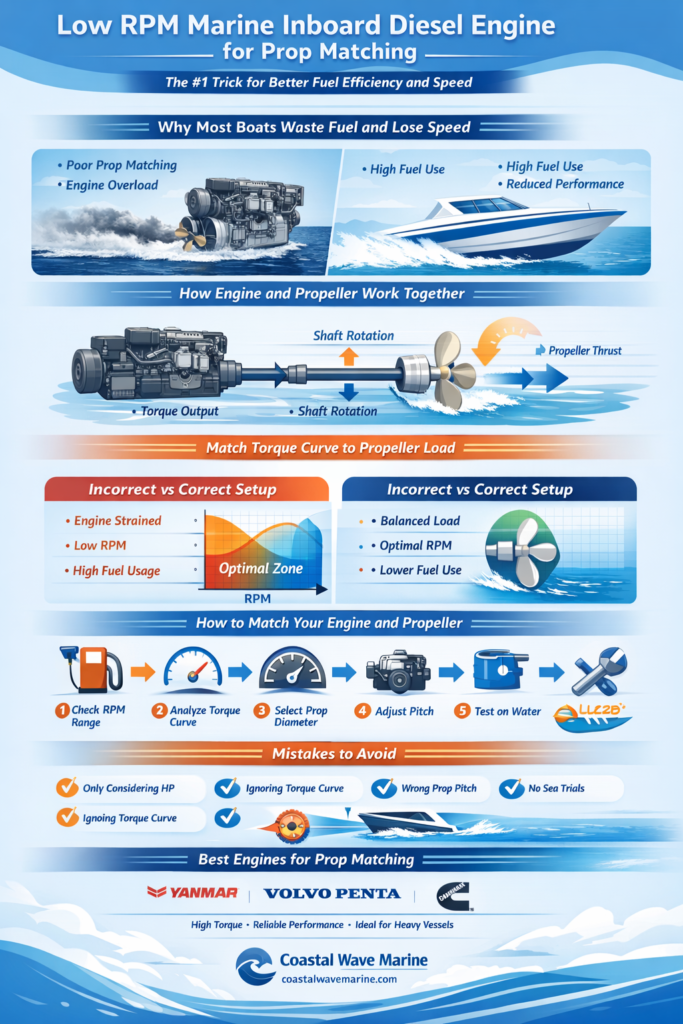
How to Match Your Propeller to a Low RPM Marine Diesel Engine
At Coastal Wave Marine, we follow a structured process:
- Confirm engine rated RPM and torque characteristics
- Measure vessel load and operating conditions
- Select initial prop diameter based on hull requirements
- Adjust pitch to balance load and RPM
- Conduct sea trials to validate performance
This process ensures that the engine operates within its intended design limits.
For those researching how to match propeller with low rpm marine diesel engine, this method reflects industry-standard practice. For additional technical background, marine propulsion principles are well documented in resources such as marine propeller theory explained.
Signs You Have the Perfect Prop Match
A properly matched system produces consistent and measurable results:
- Engine reaches rated RPM without strain
- Fuel consumption aligns with expected performance
- Smooth and predictable acceleration
- Stable cruising under load
These indicators confirm that the low rpm marine inboard diesel engine for prop matching has been configured correctly.
Real-World Case Study from Coastal Wave Marine
One commercial operator approached us with rising fuel costs despite stable operating conditions.
After analyzing the setup, we identified that the propeller was mismatched to the engine’s torque output.
We implemented adjustments based on low rpm marine inboard diesel engine for prop matching efficiency tips, including pitch correction and load balancing.
The outcome:
- Noticeable reduction in fuel consumption
- Improved engine responsiveness
- Increased operational reliability
This is a typical result when proper technical alignment is applied.
Common Mistakes to Avoid When Matching Engines and Props
Even experienced operators make these mistakes:
- Selecting engines based only on horsepower
- Ignoring torque curves and load characteristics
- Using incorrect propeller pitch
- Skipping performance testing under real conditions
Avoiding these errors significantly improves long-term efficiency and reliability.
Why Low RPM Marine Diesel Engines Are Ideal for Long-Term Efficiency
Low RPM diesel engines are widely used in marine applications for a reason.
They offer:
- High torque output for heavy loads
- Lower fuel consumption over extended operation
- Proven durability in demanding environments
For long-distance travel and commercial use, a low rpm marine inboard diesel engine for prop matching for fuel efficiency provides consistent and predictable performance.
Where to Buy the Right Low RPM Marine Inboard Diesel Engine for Prop Matching
Choosing the right supplier is as important as selecting the engine itself.
A reliable supplier should provide:
- Verified engine specifications
- Technical support for prop matching
- Warranty coverage
- Post-sale guidance
At Coastal Wave Marine, we focus on delivering complete solutions, not just products. Our marine diesel engines are selected and tested to ensure compatibility with real-world prop matching requirements.
If you are planning an upgrade, explore our marine diesel engine range designed specifically for efficient prop matching and long-term performance.

Frequently Asked Questions
What RPM is best for a marine diesel engine?
The optimal RPM depends on the engine model, but it must operate within the manufacturer’s recommended range under load.
How do I know if my propeller is correctly matched?
The engine should reach its rated RPM without excessive strain during operation.
Can the wrong propeller damage my engine?
Yes. Incorrect propeller specifications can lead to overload, overheating, and premature wear.
Are low RPM marine engines better for fuel efficiency?
Yes. Their torque characteristics allow for efficient operation at lower speeds.
How often should prop matching be checked?
It should be reviewed whenever there are changes in engine, propeller, or vessel load conditions.
Conclusion
After working with a wide range of vessels and engine configurations, one conclusion remains consistent.
Performance is not determined by engine size alone. It is determined by how well the system is matched.
A properly configured low rpm marine inboard diesel engine for prop matching delivers measurable improvements in fuel efficiency, speed, and long-term reliability.
When the engine and propeller are aligned correctly, the difference is not subtle. It is immediate and sustained.
And that is what separates a functional setup from a truly efficient one.

Leave a Reply