
If you operate a workboat, you don’t measure success in knots.
You measure it in cost per hour.
At Coastal Wave Marine, we work with commercial operators running anywhere from 1,500 to over 6,000 engine hours annually. Fishing vessels, tug operators, harbor service boats, offshore support craft — vessels that don’t get weekends off.
And across nearly every consultation, one concern dominates:
“How do we reduce fuel burn without compromising reliability?”
The answer begins with selecting the right fuel efficient marine inboard diesel engine for workboats — not simply the highest horsepower option or the lowest upfront price.
This guide reflects what we’ve learned from years of supplying commercial propulsion systems: fuel efficiency is engineered, not advertised.
Fuel Cost Reality: Why Efficiency Is a Strategic Decision
Let’s look at real numbers.
A workboat burning 20 gallons per hour operating 3,000 hours annually consumes 60,000 gallons per year.
At conservative fuel pricing, even a 5% improvement in fuel efficiency equates to thousands of dollars saved annually.
When we help clients select a fuel efficient marine inboard diesel engine for workboats operating under commercial duty, we review manufacturer fuel consumption charts — not marketing brochures.
We evaluate:
- Grams per kWh at working RPM
- Brake specific fuel consumption (BSFC) curves
- Load percentage efficiency zones
- Real-world propeller demand
Because minor improvements at operating load produce long-term financial impact.
What Defines a True Fuel Efficient Marine Inboard Diesel Engine for Workboats?
Not every diesel engine marketed as “efficient” performs efficiently under sustained commercial load.
A properly specified fuel efficient marine inboard diesel engine for workboats in continuous operation typically exhibits:
- Conservative horsepower-to-displacement ratio
- Optimized combustion chamber design
- Electronic fuel management (where applicable)
- Stable torque output at 70–85% load
- Fuel curves optimized for steady RPM
Commercial vessels do not operate like pleasure craft. They operate under predictable, sustained load profiles. Efficiency must be evaluated under those conditions. Manufacturers publish fuel maps based on ISO 3046 engine performance standards, which define how marine diesel engines are rated and tested under controlled conditions.
Duty Rating: The First Non-Negotiable Factor
One of the most common causes of excessive fuel consumption is duty misapplication.
Manufacturers classify engines into duty ratings such as:
- Light duty
- Medium duty
- Heavy duty
- Continuous duty
A fuel efficient marine inboard diesel engine for workboats must align with actual operating hours and load percentage.
We’ve reviewed cases where operators installed engines rated for intermittent duty but operated them at sustained high load. The result:
- Increased fuel consumption
- Elevated exhaust temperatures
- Reduced component lifespan
Fuel efficiency deteriorates rapidly when engines operate outside intended duty parameters.
Correct duty rating protects both fuel economy and engine longevity. Look for continuous duty marine inboard diesel engines.
Understanding Fuel Curves and Load Efficiency
Fuel efficiency is not static across the RPM range.
Manufacturers publish fuel maps indicating:
- Fuel consumption per hour at various RPM
- Specific fuel consumption per kW output
- Optimal load zones
Most commercial diesel engines achieve best fuel efficiency between 70% and 85% load.
Below that range:
- Combustion efficiency declines
- Carbon accumulation increases
Above that range:
- Fuel delivery increases disproportionately
- Thermal stress rises
When recommending a fuel efficient marine inboard diesel engine for workboats in commercial maritime operations, we calculate expected load percentage based on:
- Vessel displacement
- Propeller demand
- Gear ratio
- Operating RPM
Efficiency begins with accurate load modeling.
Proper Engine Sizing: Avoiding Overspecification
Oversizing is one of the most expensive mistakes in commercial propulsion.
An oversized engine running underloaded can result in:
- Incomplete combustion
- Higher fuel burn per kWh
- Carbon buildup
- Lower thermal efficiency
Conversely, undersizing forces engines to operate continuously above optimal load.
The correct fuel efficient marine inboard diesel engine for workboats is neither the biggest nor the smallest — it is the one that operates within its optimal fuel efficiency band under real-world operating conditions.
At Coastal Wave Marine, we analyze projected operating profiles before recommending horsepower.
Propulsion System Integration: Engine + Gearbox + Propeller
Fuel efficiency does not exist in isolation.
It is influenced by:
- Gear reduction ratio
- Propeller diameter and pitch
- Hull resistance
- Vessel load distribution
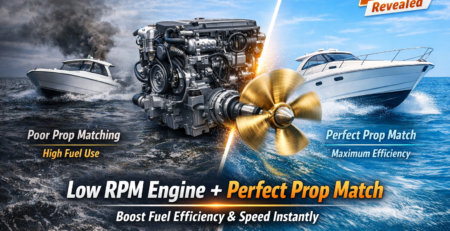
Even the most advanced fuel efficient marine inboard diesel engine for workboats will underperform if paired with improper propeller configuration.
We routinely advise operators to evaluate the entire propulsion system rather than replacing engines alone.
In several documented cases, correcting propeller pitch improved fuel consumption by measurable margins without changing the engine. Check our marine gearboxes for commercial vessels.
Cooling Efficiency and Thermal Stability
Thermal control directly affects fuel burn.
Engines operating above ideal temperature thresholds consume more fuel and degrade faster.
A properly configured fuel efficient marine inboard diesel engine for workboats operating long hours will include:
- Adequate heat exchanger sizing
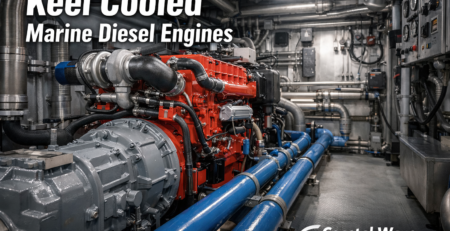
- Keel cooling where appropriate
- Stable coolant flow rates
Maintaining stable operating temperature supports consistent combustion and long-term efficiency. We have marine generators for workboats.
Emissions Standards and Modern Efficiency Gains
Modern marine diesel engines designed to meet:
- IMO Tier II / III
- EPA marine diesel standards
often incorporate improved injection timing, combustion optimization, and electronic management systems.
Many newer fuel efficient marine inboard diesel engine for workboats compliant with regulatory standards offer improved fuel atomization and reduced particulate output.
Regulatory compliance frequently aligns with improved efficiency — not reduced performance. Modern engines are built to meet IMO marine diesel emission standards, which regulate nitrogen oxide (NOx) output for commercial vessels operating internationally.
Maintenance Discipline and Long-Term Efficiency
Fuel efficiency deteriorates without proper maintenance.
Critical factors include:
- Injector calibration
- Air filter condition
- Cooling system integrity
- Lubrication quality
- Fuel quality management
Even the best fuel efficient marine inboard diesel engine for workboats will lose efficiency if neglected.
Commercial operators who adhere to recommended service intervals typically maintain stable fuel consumption over thousands of operating hours.
Practical Applications: Where Efficiency Delivers Impact
A fuel efficient marine inboard diesel engine for workboats is particularly valuable in:
- Commercial fishing vessels with long trawling cycles
- Tugboats operating under steady torque
- Harbor utility craft
- Offshore support vessels
- Patrol boats with extended duty shifts
In these applications, operational consistency allows efficiency gains to compound. Many modern platforms comply with EPA marine compression-ignition engine regulations, particularly for workboats operating in U.S. waters.
Vendor Experience Matters
Selecting a fuel efficient marine inboard diesel engine for workboats is not a catalog decision.
It requires:
- Load evaluation
- Fuel curve analysis
- Gearbox compatibility review
- Cooling system assessment
- Regulatory compliance review
At Coastal Wave Marine, we assist operators with:
- Pre-delivery inspection
- Configuration verification
- Technical consultation
- Global logistics coordination
Our goal is not to sell the highest horsepower engine.
It is to optimize operational cost over the next 10–15 years.

FAQ – Fuel Efficient Marine Inboard Diesel Engine for Workboats
How much fuel can a fuel efficient marine inboard diesel engine for workboats save annually?
A properly matched engine can reduce fuel consumption by 5–15% annually. On a vessel running 3,000 hours per year, this can translate into thousands of gallons saved depending on load and setup.
What is the ideal load percentage for fuel efficiency?
Most commercial marine diesel engines operate most efficiently between 70% and 85% load at normal working RPM.
Are electronic marine diesel engines more fuel efficient?
In many cases, yes. Electronic fuel management improves injection timing and fuel delivery, helping optimize combustion under load.
How does gearbox selection affect fuel consumption?
An incorrect gearbox ratio can push the engine outside its optimal efficiency range. Proper matching improves fuel economy and reduces strain.
How long does a commercial marine diesel engine last?
With proper maintenance and correct duty rating, most commercial marine diesel engines last 15,000–25,000 hours before major overhaul.
Final Perspective: Efficiency Is a Financial Strategy
A workboat is an income-generating asset.
Fuel is one of its largest recurring expenses.
Choosing the correct fuel efficient marine inboard diesel engine for workboats operating under commercial duty cycles reduces:
- Cost per hour
- Downtime
- Long-term overhaul frequency
- Total lifecycle expense
Efficiency is not about chasing innovation.
It is about aligning engineering with operating reality.
The smartest operators do not ask, “What engine has the most horsepower?”
They ask:
“What engine gives me the lowest cost per hour over the next decade?”
That question leads to better decisions — and better fleets.
Next Post: Continuous Duty Marine Inboard Diesel Engine: The Power Solution for Long-Hour Commercial Operations
Leave a Reply