
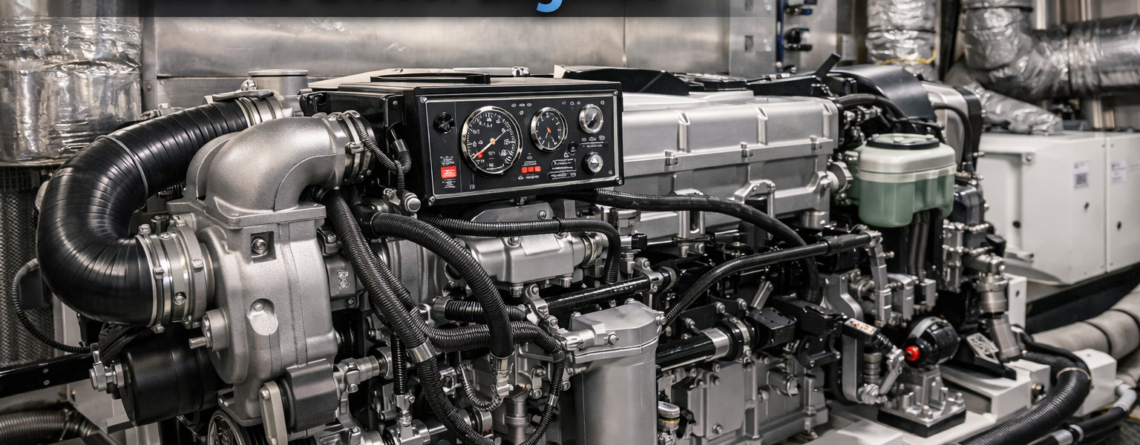
In the marine engine industry, you don’t really notice change when it starts. You notice it when the questions from buyers change.
At Coastal Wave Marine, we’ve been supplying marine inboard diesel engines for commercial and professional use long enough to see this shift clearly. Years ago, most buyers asked about horsepower, price, and availability. Today, the first question is often much more specific:
“Is this engine fully IMO emissions compliant, and can you prove it?”
That single question explains why IMO emissions compliant marine inboard diesel engines are steadily replacing older power systems across commercial fleets, workboats, and export-bound vessels worldwide.
This transition isn’t driven by marketing or trends. It’s driven by regulation, operating economics, inspection realities, and long-term asset protection.
What Changed in the Real World (Not on Paper)
From the outside, emissions compliance can look like a regulatory issue. From the inside — where engines are bought, installed, inspected, financed, and resold — it’s a risk-management issue.
We’ve worked with vessel owners who were forced to delay operations because an engine passed mechanically but failed documentation checks. We’ve also seen vessels lose resale value because buyers couldn’t verify emissions compliance, even though the engine itself was in good condition.
Those situations are becoming more common, not less.
That’s why experienced operators are now prioritizing IMO emissions compliant marine inboard diesel engines at the engine-selection stage, not after a problem appears.

What IMO Emissions Compliance Actually Means for Engine Buyers
The International Maritime Organization sets global emissions standards to reduce harmful exhaust from marine engines. While the technical classifications (Tier II, Tier III) can be complex, the implications for buyers are very practical.
An IMO-compliant engine must:
- Meet verified emissions thresholds
- Be supported by formal certification
- Align with inspection and port authority requirements
- Remain acceptable across jurisdictions
From a buyer’s perspective, compliance is not theoretical. It determines whether:
- A vessel passes inspection
- Insurance remains valid
- Financing is approved
- A resale deal moves forward
An IMO emissions compliant marine inboard diesel engine removes uncertainty from all four. Looking for an IMO emissions compliant marine inboard diesel engines.
Why Older Marine Inboard Diesel Power Systems Are Being Phased Out
Regulations Are Becoming Operational Constraints
Regulations don’t suddenly shut down vessels — they create friction.
We see it when:
- Ports request emissions documentation
- Surveyors flag older engines
- Buyers demand compliance verification before closing
Even when older engines are still legal in limited regions, their operational flexibility is shrinking. That’s why many fleet operators are upgrading preemptively rather than waiting for enforcement to force the decision.
Legacy Engines Cost More Over Time Than Most Owners Expect
Another reason older engines are being replaced isn’t regulation — it’s economics.
Legacy marine diesel engines often bring:
- Higher fuel consumption
- Longer maintenance cycles
- Hard-to-source parts
- Reduced efficiency under modern duty cycles
In contrast, modern fuel-efficient IMO emissions compliant marine inboard diesel engines are designed for current operating realities, not past assumptions.
We’ve seen operators calculate lifecycle costs and realize the “cheaper” engine was only cheaper on day one.
You can check the marine engine emissions standards for more details.
How IMO Emissions Compliant Marine Inboard Diesel Engines Address These Issues
Cleaner Combustion With Proven Reliability
There’s a misconception that emissions compliance compromises performance. That hasn’t been true for years.
Modern compliant engines achieve lower emissions through:
- Precision fuel injection
- Optimized combustion geometry
- Advanced engine control systems
From a practical standpoint, torque delivery and reliability remain intact — often improved — while emissions output drops.
This is why commercial operators are comfortable transitioning entire fleets to IMO emissions compliant marine inboard diesel engines for commercial vessels.
Measurable Fuel Efficiency Gains
Fuel efficiency is not a marketing metric — it’s an operating line item.
Engines designed to meet IMO standards typically:
- Burn fuel more completely
- Operate within optimal load ranges
- Reduce long-term wear
Over thousands of operating hours, even modest efficiency gains translate into meaningful cost reductions.

What We See Consistently at Coastal Wave Marine
Because we work directly with buyers across regions and vessel types, patterns emerge quickly.
Today’s professional buyers:
- Ask for emissions certificates early
- Request documentation before pricing
- Evaluate engines based on long-term compliance, not short-term cost
This shift has made IMO emissions compliant marine inboard diesel engines the default recommendation for most commercial and export projects we support.
Not because they’re fashionable — because they reduce risk. You can learn more about us or contact us for more details.
Compliance and Resale Value: The Overlooked Advantage
One of the most underestimated benefits of compliance is asset protection.
Vessels powered by compliant engines:
- Sell faster
- Attract serious buyers
- Avoid last-minute renegotiations
- Pass due diligence more smoothly
We’ve seen transactions stall or collapse entirely because compliance couldn’t be verified. Engines that are documented and traceable avoid those scenarios.
Common Mistakes Buyers Still Make
Mistake 1: Trusting Marketing Claims Without Documentation
Not all new engines are IMO compliant.
Some are built for markets with different regulatory expectations. Without proper certification, those engines may fail inspection even if they perform well mechanically.
That’s why we always emphasize verified IMO emissions compliant marine inboard diesel engines with full supporting documentation.
Mistake 2: Ignoring Application Fit
Compliance alone doesn’t guarantee success.
Engines must still match:
- Vessel size
- Operating profile
- Load demands
- Service expectations
An IMO-compliant engine that’s poorly matched to its duty cycle can create efficiency and maintenance problems. Proper selection matters.
Why Specialized Marine Engine Suppliers Matter
Marine inboard diesel engines are capital assets. Buyers increasingly prefer suppliers who:
- Understand emissions regulations in practice
- Provide correct documentation
- Offer application-specific guidance
- Support long-term ownership considerations
This is where specialized suppliers add value beyond the transaction itself.
When IMO Emissions Compliant Marine Inboard Diesel Engines Make the Most Sense
They are the right choice for:
- Commercial vessels
- International operations
- Fleet owners
- Buyers concerned with resale, financing, and inspections
While legacy engines may still operate in narrow use cases, most owners we work with are already planning the transition.
Frequently Asked Buyer Questions
Are IMO emissions compliant marine inboard diesel engines mandatory worldwide?
Not everywhere yet, but enforcement is expanding rapidly.
Do IMO-compliant engines cost more upfront?
Sometimes slightly, but long-term savings often offset the difference.
Can older vessels be upgraded successfully?
Yes, with correct planning and engine selection.
Why This Shift Is Permanent
From our perspective, this is not a temporary cycle.
IMO emissions compliant marine inboard diesel engines are replacing older power systems because they align with where marine operations are going — not where they’ve been.
They reduce regulatory exposure, improve operating efficiency, and protect vessel value.
At Coastal Wave Marine, our role is to help buyers make those decisions with clarity and confidence — before compliance becomes a problem instead of a strategy.
Next Post: Best Marine Inboard Diesel Engines for Commercial Use 2026 Explained by Marine Engine Suppliers
Leave a Reply